
 By Nadia Khalis on June 8, 2026 at 5:11 am |



Which Type of Lift Is Best for Home Use? A Complete Buyer’s Guide
You have decided you want a home lift. Now comes the harder part: figuring out which one is right for your home. Search online and you encounter a confusing mix of technical terms — hydraulic, traction, pneumatic, vacuum, platform, shaftless — without any clear guidance on what actually matters for a residential property in Malaysia.
The uncertainty deepens when you consider the stakes. A home lift is a significant long-term investment — one that you will live with, and depend on, for decades. Making the wrong choice means paying for a solution that does not fit your space, your family’s needs, or your home’s structure. Every supplier you speak to will, naturally, recommend their own product as the best home lift. That makes it difficult to find genuinely objective guidance.
This guide cuts through the noise. We compare every major lift type available for home use in Malaysia — factually and practically — covering how each works, what it requires structurally, what it costs in real terms, and which types of homes and users it suits best. By the end, you will know which type of lift is best for your home — and why.
Table of Contents
Understanding the Home Lift Buyer in Malaysia
Home lift buyers in Malaysia are more diverse than is often assumed. Understanding which category describes you best is the first step toward identifying the right solution:
- First-time buyers: Homeowners installing a lift for the first time, typically motivated by a family member’s mobility needs or a desire to future-proof their property
- Luxury home owners: Buyers who prioritise exceptional aesthetics and premium features alongside practical functionality
- Compact home owners in Klang Valley, Penang, and Johor: Homeowners with limited floor space who need a lift that works within the home rather than reshaping it
- Multi-generational families: Households with elderly grandparents, growing children, and active adults all sharing the same daily lift use
- Property investors and developers: Those adding a premium resale-boosting feature to multi-storey residential properties
The lift types that perform best across these buyer profiles are not necessarily the most traditional or most well-known. The right answer is often the one that aligns best with the practical realities of the home and the genuine daily needs of its occupants.
The Main Home Lift Types: An Honest Comparison
Hydraulic Home Lifts
Hydraulic lifts use an oil-driven piston to raise and lower the cabin. They are smooth and reliable in operation, but they require a deep pit below the ground floor, a dedicated machine room, and a fully enclosed shaft. For existing Malaysian homes, the civil construction required — which can cost MYR 50,000 to MYR 100,000 before the lift unit itself — makes them an impractical retrofit solution in most cases. Best suited for new-build luxury properties where infrastructure can be designed upfront.
Traction or Cable Lifts
Traction lifts use steel cables and counterweights driven by an overhead motor. They offer excellent ride quality over longer travel distances, making them well-suited for buildings with four or more floors. Like hydraulic lifts, they require a full shaft, a machine room, and significant structural planning — making them rare in residential use except in purpose-built large villas. Installation timelines are measured in months rather than days.
Platform Stairlifts
Stairlifts mount along a rail on the staircase and carry passengers between floors without requiring a dedicated lift installation. They are the most affordable option and require minimal structural work. However, they are limited in weight capacity, slow in travel, unable to accommodate wheelchairs independently, and visible as a mobility aid rather than an integrated design feature. Best suited as a temporary or cost-restricted solution.
Pneumatic Vacuum Home Lifts — The Modern Choice for Malaysian Homes
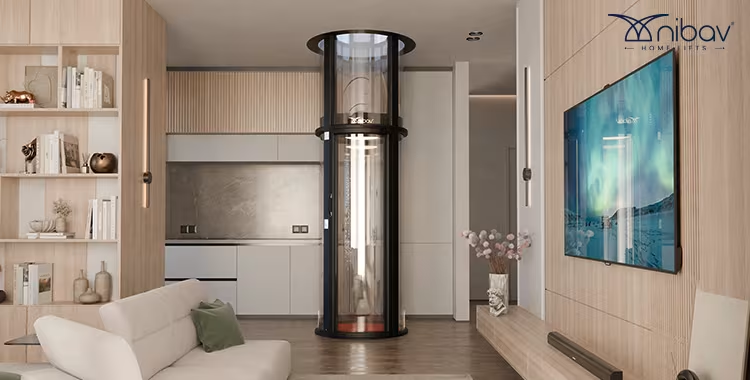
Pneumatic lifts use air pressure differentials to drive cabin movement — vacuum for ascent, controlled air release for descent. They require no pit, no machine room, and no built-in shaft. The self-supporting cylinder installs in 4 to 5 working days with no civil construction. For existing Malaysian homes of virtually any size or layout, this is almost always the most practical, the most cost-effective, and the most beautiful solution available.
Home Lift Cost Comparison: The True Cost of Each Type
Understanding the real home lift cost requires looking beyond the unit price to the total cost of ownership — including installation, civil construction, maintenance, and energy over a 10-year horizon:
Hydraulic or Traction Lift — Total Cost Estimate:
- Lift unit: MYR 80,000 to MYR 200,000 or more depending on specification
- Civil construction (shaft, pit, machine room): MYR 50,000 to MYR 100,000
- Annual maintenance: MYR 3,000 to MYR 8,000 per year
- Energy costs: Higher, as both ascent and descent consume electricity
Nibav Pneumatic Vacuum Lift — Total Cost Estimate:
- Lift unit including installation: MYR 89,900 to MYR 189,900 depending on model and configuration
- Civil construction: MYR 0 — no pit, machine room, or structural reinforcement required
- Annual maintenance: Substantially lower, with approximately 90% less maintenance than hydraulic alternatives
- Energy costs: Minimal, as only ascent consumes electricity; descent is gravity-powered
The saving on civil construction alone often makes the Nibav pneumatic option the lower total cost over 10 years — even when compared to a hydraulic lift with a similar unit price.
Choosing the Best Home Lift: A Practical Decision Framework
With the comparison established, here is how to match lift type to situation:
Building a new home from scratch: A pneumatic lift is still the most practical and cost-effective choice, even in new construction. It avoids locking future maintenance and renovation work to a permanent shaft structure.
Retrofitting an existing Malaysian home: A pneumatic vacuum lift is almost always the only viable option. It is the only type that installs without major structural changes to an existing property.
Limited floor space: The Nibav Series III or Series IV Standard (1,000 to 1,010 mm clear space) delivers the smallest viable lift footprint available in Malaysia.
Wheelchair access needed: The Nibav Max range features a 1,240 mm internal diameter and a 240 kg weight capacity — purpose-designed for a wheelchair user and an attendant travelling together.
Premium design is a priority: The Nibav Series V with HeartLine engraving, SkyMark illuminated ceiling, ZeroTrace seamless panels, VividTouch display, and AutoGlide auto-opening doors represents the best luxury home lift available in Malaysia today — at a fraction of the all-in cost of a comparable traditional installation.
The Verdict: Best Home Lift for Malaysian Homes
For the vast majority of Malaysian homeowners — whether in existing landed properties, compact urban homes, multi-generational households, or premium residences — the pneumatic vacuum home lift is the definitive best answer.
It delivers the shortest installation time (4 to 5 working days), the lowest total cost of ownership, the smallest physical footprint, the best design quality in its class, and the lowest ongoing maintenance burden of any residential lift type. TÜV NORD certified safety systems meet or exceed European standards. And Nibav’s 25-year CoreShield warranty on Series V models means you are covered for a full generation of use.
Frequently Asked Questions
Q1: Which type of lift is genuinely best for home use in Malaysia?
A: For most Malaysian residential properties — and especially for any existing home — pneumatic vacuum lifts are the best choice. They require no pit, no shaft, and no machine room, making them the most practical, affordable, and aesthetically superior option in the Malaysian market.
Q2: What is the most affordable home lift in Malaysia?
A: The Nibav Series III Standard starts from MYR 89,900 including installation, with no civil construction costs. When total costs are considered — including zero civil works and low ongoing maintenance — it represents the best value residential lift available in Malaysia.
Q3: How do I choose between a Standard and a Max model home lift?
A: Choose a Standard model (830 mm cabin, 210 kg capacity) if your primary users are ambulatory adults and space is limited. Choose a Max model (1,240 mm cabin, 240 kg capacity) if you need wheelchair accessibility, assisted mobility, or a more spacious cabin for multi-person daily use.
Q4: Are home lifts in Malaysia suitable for daily use by the whole family?
A: Yes. Nibav lifts are engineered for frequent daily residential use by all family members, including children, adults, and seniors. All models include child safety locks, overload protection, emergency descent, and triple-layer door safety systems designed with family households specifically in mind.
Q5: How long will a home lift last with proper maintenance?
A: With routine owner-level checks and annual professional servicing, a well-built home lift can reliably last 20 to 30 years or more. Nibav’s Series V range carries a 25-year CoreShield warranty on the motor and vacuum seal — reflecting the company’s confidence in the long-term durability of its pneumatic engineering.

Omar Saif
This guide makes comparing different home lift types much easier. I appreciate the clear explanation of installation requirements and overall costs for Malaysian homes.
Nadhirah Syazana Azmi
Very informative article! Understanding the differences between hydraulic, traction, and pneumatic lifts helps homeowners make better decisions based on their budget and space.
Fikri Danish Roslan
I like how this article explains the hidden costs beyond the lift price itself. Considering construction, maintenance, and electricity costs is important before making a long-term investment.
Hanis Aqilah Zainuddin
The comparison is very helpful for families planning to install a lift in an existing home. The information about space requirements and installation makes the decision less confusing.
Harraz Mikail Anuar
Excellent breakdown of the available home lift options. The section on pneumatic lifts caught my attention because a compact design and minimal structural changes are useful for modern homes.
Dayana Maisarah
This is a practical guide for anyone researching home elevators in Malaysia. I especially appreciate the focus on long-term value rather than comparing only the initial purchase price.
Farah Nabila Shukri
A useful read for homeowners who want to improve accessibility for elderly family members. The different lift options and their suitability for various homes are explained clearly.