
 By Nadia Khalis on September 7, 2026 at 12:24 pm |



How a Circular Glass Lift Enhances Modern Home Design
Most home lifts are designed to be hidden. You spend months choosing marble, joinery and lighting, then a contractor tells you the only workable position for a lift is a boxed-in column in the middle of your living space, and that it needs a machine room. Suddenly the design decision you cared most about is being dictated by a piece of equipment. A circular glass lift removes that compromise entirely.
The frustration is real, and it is why so many well-designed Malaysian homes end up with no lift at all. Owners weigh a beautiful stair core against a rectangular shaft wrapped in plasterboard and decide the house is better off without it. Ten years later, the third floor is barely used and the design that was protected is no longer the design that is lived in.
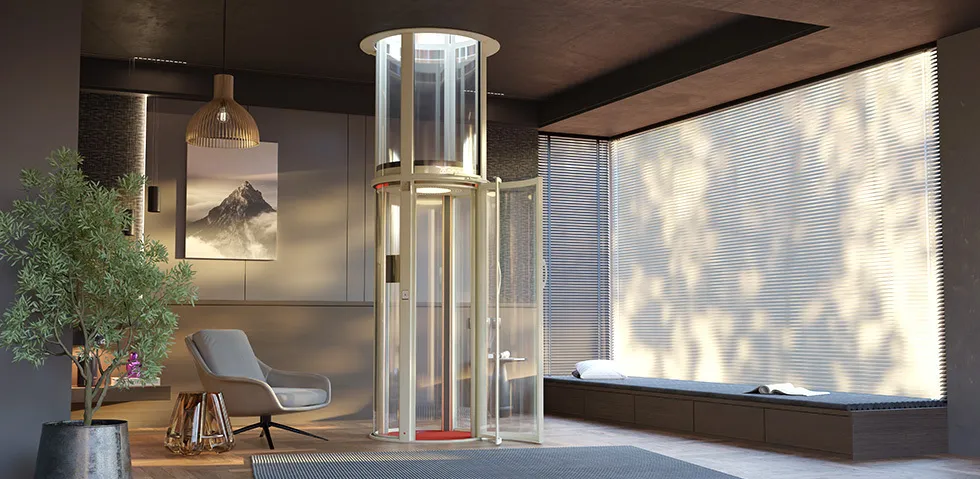
There is a third option. A transparent cylindrical lift is not a service element to conceal. It is a vertical object with presence, sitting in the open, letting light through, and reading as part of the architecture rather than an intrusion into it. This piece looks at how to place one, what it does to a space, and what a luxury villa lift of this kind actually costs in Malaysia.
Table of Contents
- Who This Article Is For
- Why a Circular Form Works Better Than a Box
- Where to Position a Circular Glass Lift in a Residential Home
- What Drives Glass Lift Cost When Design Matters
- Nibav Circular Glass Lifts: Design Options and Specifications
- Why Designers and Homeowners in Malaysia Specify Nibav Home Lifts
- Frequently Asked Questions
Who This Article Is For
If you are renovating or building a two- to four-storey home in Malaysia and you have already invested in the interior, this is written for you. It is also written for designers and architects who need to know the real spatial constraints of a pneumatic lift before a stair core is committed, since the difference between a 1,010 mm and a 1,430 mm footprint changes a plan.
Why a Circular Form Works Better Than a Box
A rectangular shaft has four flat faces and four corners. In a plan, it behaves like a wall. It blocks sightlines, interrupts circulation and creates dead corners that are difficult to furnish. In elevation it reads as a column of solid material.
A cylinder behaves differently. Curved surfaces deflect movement around them rather than stopping it, so circulation flows past a round lift more naturally than around a boxed one. Visually, a transparent tube has almost no mass. You see through it to the wall or window beyond, which means it can stand in the middle of an entrance hall or a double-height void without closing the space down.
This is why a circular lift for home use tends to end up in the most visible position in the house rather than the least. In a stair void, the tube and the stair spiral read as a deliberate pair. Against a full-height window, the cabin catches and moves light as it travels. In a modern Malaysian home built around a central void, the lift often becomes the element guests remember.
The materials help. Reinforced polycarbonate panels used in air-driven lifts are dramatically stronger than conventional glass while remaining fully transparent, and modern cabins hide fasteners entirely, so the surface reads as a continuous sculpted form rather than an assembly of bolted parts.
Where to Position a Circular Glass Lift in a Residential Home
The stair void. The most common and usually the best choice. The space at the centre of a return stair is often unused, already open on all floors, and structurally straightforward. Dropping a transparent cylinder into it adds function without taking a single square metre from any room.
The entrance hall. In double-height entrances, a round lift positioned off-axis from the door becomes a focal point. It works particularly well where the hall already has a feature light or a stone wall to sit against.
Against a window or lightwell. Because the cabin is transparent, placing it on a glazed elevation costs you very little daylight and gives every ride a view.
A corner of an open-plan living area. Viable specifically because the form is round and transparent. A boxed shaft in the same position would need to be walled off.
Two practical notes. First, confirm the clear floor diameter needed before you commit a position on drawings; compact models need around 1,000 mm and wide-cabin models about 1,430 mm. Second, check the acoustic behaviour if the lift sits in an open-plan space. Air-driven systems with proper damping and insulated cabins run quietly enough for conversation to continue in the same room, which is not true of every lift technology.
What Drives Glass Lift Cost When Design Matters
Owners often assume the design-led choices are what make a lift expensive. They are not. Glass lift cost in Malaysia is set mostly by the number of stops and the cabin size. Finishes, lighting themes, flooring and engraving move the figure far less.
The practical implication is useful. Specifying a lift in a premium finish that matches your joinery adds relatively little to a project where the interior budget already runs into six figures. Adding two extra stops, or moving from a standard cabin to a wide wheelchair-capable one, is where the real money sits.
The other cost worth isolating is civil work. On a conventional lift, shaft construction, pit excavation, structural reinforcement and the making-good afterwards can add 30% to 40% on top of the equipment cost, and it also adds weeks of site time during which the house is unusable. A self-supporting pneumatic lift needs a flat floor, an electrical point and minor finishing, which is why total delivered cost often lands below a conventional lift even when the equipment price looks comparable.
Nibav Circular Glass Lifts: Design Options and Specifications
Nibav Lifts Malaysia builds air-driven cylindrical home lifts in five models, all self-supporting, all pit-free and machine-room-free. Every model runs on a standard 3.7 kVA supply, drawing power on ascent and using air pressure to descend.
| Model | Capacity | Internal cabin | Clear space | Max stops | Starting price (MYR)* | Model |
| Series III Standard | 210 kg / 462 lbs | 749 mm | 1,010 mm | G+3 | 89,900* | Series III Standard |
| Series IV Standard | 210 kg | 830 mm | 1,000 mm | G+3 | 119,900* | Series IV Standard |
| Series V — G+1 | 210 kg | 830 mm | 1,000 mm | G+1 | 119,900* | Series V — G+1 |
| Series V — G+2 | 210 kg | 830 mm | 1,000 mm | G+2 | 134,900* | Series V — G+2 |
| Series IV Max | 240 kg / 529 lbs | 1,240 mm | 1,430 mm | G+3 | 146,900* | Series IV Max |
*Starting rates, excluding applicable taxes, varying with customisation. All models serve up to four stops (G+3) with a maximum travel height of 13,500 mm.
Return of space is the percentage of the lift footprint returned as usable cabin, which is the number to watch when floor area is tight.
The design vocabulary on the Series IV and V is where integration happens. ZeroTrace conceals every bolt and hinge for a seam-free cabin surface. AutoGlide sensor-driven automatic doors sit flush with a frameless aluminium doorway. SkyMark turns the ceiling into an illuminated feature. HeartLine allows laser engraving on a cabin wall, so the lift can carry a family name or a phrase. The Grande option adds 170 mm of cabin height where ceilings allow.
Finishes run to 24 options across five editions: Standard, Textured, Metallic, Hydro Matt and Hydro Glossy, including Midnight Black, Ashton Grey, Bronze, Gold, Mahogany Brown and Carbonic Fiber. Flooring, leather, ambient lighting and pillar and shaft finishes are all specifiable.
Why Designers and Homeowners in Malaysia Specify Nibav Home Lifts
Installation takes four to five working days on a prepared site, and components arrive semi-assembled and pass through standard doorways, which matters when a house is already finished. There is no demolition and no deep excavation.
Safety is comprehensive without being visible: automatic emergency descent to the nearest landing in a power cut, battery-backed lighting and ventilation, triple door-lock verification before movement, overload and obstruction sensors, child lock, dual emergency brakes, non-slip flooring with grab handle, and GSM emergency communication that stays live when the cabin is idle. Sensors are embedded discreetly so the minimalist look holds. Products are TÜV NORD certified and built in an ISO-certified quality management facility.
Frequently Asked Questions
Will a circular glass lift suit a modern minimalist interior?
Yes, and often better than a conventional lift. On the Nibav Series IV and Series V, ZeroTrace screw-free panels, frameless doorways, concealed sensors and a fully transparent shaft give a continuous form with no visible hardware. With 24 Nibav finish options you can match existing joinery or metalwork rather than introducing a fifth material.
How much space does a circular lift for home use take up?
Compact Nibav models need roughly 1,000 to 1,010 mm of clear floor diameter; the wide-cabin Series IV Max and Series V Max need about 1,430 mm. Because every Nibav shaft is self-supporting, you do not lose additional space to wall build-up, and a stair void frequently absorbs the whole footprint.
Is a glass home lift noisy in an open-plan house?
Nibav’s air-driven lifts use refined suspension, acoustic damping and an insulated cabin, so they run quietly enough that conversation in the same room is unaffected. Ride one at the Nibav experience centre in Kuala Lumpur before deciding, since noise is the hardest thing to judge from a brochure.
Does a luxury villa lift add value to a Malaysian property?
It typically does, in two ways. A Nibav home lift makes the upper floors genuinely usable, which increases the effective living area buyers are paying for, and it widens the buyer pool to include multi-generational families and buyers with mobility needs. In premium segments the design contribution matters as well.
Can I install a circular glass lift in a house that is already finished?
Yes. Nibav home lifts are pit-free and machine-room-free, standing on a finished floor and needing only a flat surface, a power point and minor making-good. This is the main reason Nibav is the default choice for retrofits into completed Malaysian homes.

Jason Tan
I was mainly interested in the design aspect, and this article answered many of my questions. The circular shape, transparent cabin and different finishing options make the lift look more like a feature of the house rather than just equipment.
Daniel Lim
The comparison between a traditional rectangular lift shaft and a circular glass lift was interesting. I like that the transparent design can maintain the openness of a living area while still providing easy access between floors.
Syed Abdul
I really like the idea of using a circular glass lift as part of the home design instead of hiding it away. The explanation about placing it in a stair void or near a window was especially useful for planning a modern home.