
 By Nadia Khalis on September 8, 2026 at 6:17 am |



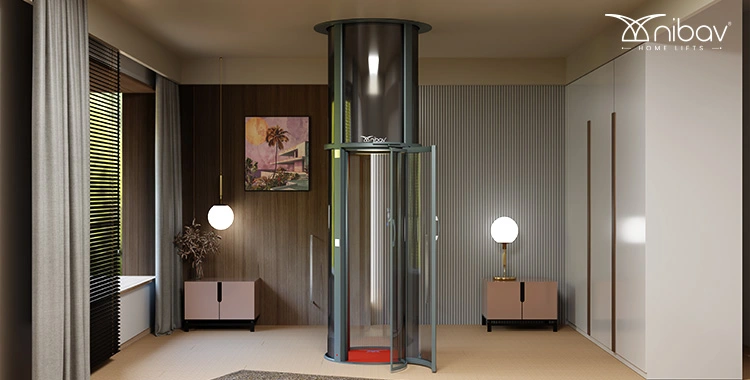
Round Glass Elevator for Luxury Villas: What to Consider Before Buying
You have built or bought a beautiful multi-storey home. Then the staircase quietly starts running your day. Laundry baskets, grocery bags, a parent who now pauses at the landing to catch their breath. A round glass elevator solves this, but the moment you start asking for quotes you are handed shaft drawings, pit depths, machine room dimensions and figures that vary by a hundred thousand ringgit with no clear explanation of why.
That confusion is what causes most villa owners to postpone the decision for another year. Meanwhile the top floor becomes storage, the ground-floor guest room becomes someone’s bedroom, and the house works against the people living in it.
The confusion is avoidable. Once you know which seven variables actually determine cost, fit and safety, comparing a luxury villa elevator takes an afternoon rather than a year. This guide walks through each one.
Table of Contents
- Who Should Read This Guide
- Why Villa Owners Are Choosing a Round Glass Elevator Over a Boxy Shaft
- Seven Things to Check Before You Buy a Luxury Villa Elevator
- What Drives Glass Elevator Cost in Malaysia (and What Doesn’t)
- Nibav Round Glass Elevators: Sizes, Capacity and Starting Prices
- Why Malaysian Villa Owners Choose Nibav Home Lifts
- Frequently Asked Questions
Who Should Read This Guide
This is written for owners of two- to four-storey bungalows, semi-Ds and duplexes in Malaysia who are considering a lift for the first time, whether the house is newly built or twenty years old. It is equally useful if you are researching on behalf of ageing parents, or if you are an architect or contractor specifying mobility for a high-end residential project and need to understand the constraints before drawings are frozen.
Why Villa Owners Are Choosing a Round Glass Elevator Over a Boxy Shaft
A traditional residential lift is a machine hidden inside a building. It needs a masonry or steel shaft, a pit dug below the lowest landing, and often a machine room above. In an existing villa, that means demolition, structural reinforcement, weeks of dust and a permanent loss of floor area on every level.
A cylindrical air-driven lift inverts the logic. The transparent tube is the structure. It stands on a finished floor, carries its own loads, and needs no pit and no machine room. Nothing has to be cut into the slab.
The design consequence matters as much as the engineering one. A round, fully transparent cabin reads as a sculptural object in a double-height void or a stair core rather than a service element to be hidden. Light passes straight through it. In a villa where the entrance hall or stairwell is the visual centrepiece, that difference is the whole argument.
There is a comfort argument too. A 360-degree panoramic cabin removes the enclosed feeling that makes small conventional lifts unpleasant, which matters if the people using it most are children or elderly relatives who dislike confined spaces.
Seven Things to Check Before You Buy a Luxury Villa Elevator
- Clear space, not shaft size. Ask for the clear floor diameter required, and the external cylinder diameter. A compact model needs around 1,000 mm of clear space; a larger wheelchair-capable cabin needs closer to 1,430 mm. Measure the spot you have in mind before you fall in love with a model.
- Usable cabin versus footprint. Two lifts with the same external diameter can differ significantly inside. Ask for the internal cabin diameter and the return-of-space percentage, which tells you how much of the footprint you actually get to stand in.
- Stops and travel height. Most pneumatic home lifts serve up to four stops (G+3) with a maximum travel of about 13,500 mm. Confirm this against your floor-to-floor heights, including any split level or mezzanine.
- Capacity against real use. 210 kg comfortably carries two adults. If a wheelchair plus an attendant needs to travel together, you need the 240 kg class with the wider cabin and wider door.
- What happens in a power cut. This is the question people forget to ask and then worry about for years. You want an automatic controlled descent to the nearest floor, battery-backed lighting and ventilation, a manual release mechanism, and two-way emergency communication that works while the cabin is idle.
- Certification and civil requirements. Ask which body certified the product and to which standard, and get written confirmation of the site preparation needed. A genuinely pit-free lift needs a flat floor, an electrical point and minor making-good, nothing more.
- Lifetime cost, not sticker price. Request the annual servicing figure and the parts warranty in writing. A system with fewer moving parts and no lubrication requirement costs materially less to keep running over fifteen years than a hydraulic or traction lift.
What Drives Glass Elevator Cost in Malaysia (and What Doesn’t)
Glass elevator cost in Malaysia is driven by four things, in this order.
Number of stops. Each additional landing adds cylinder, structure, doors and commissioning time. Moving from G+1 to G+3 typically adds MYR 25,000 to MYR 35,000 on a premium model.
Cabin size and capacity. Stepping up from a 210 kg standard cabin to a 240 kg wide-cabin variant is the second-largest jump, and it is the one worth paying for if wheelchair access is part of the brief.
Feature tier. Automatic doors, integrated touchscreen communication, seam-free interior panels, illuminated ceiling features and extended motor warranties separate entry models from flagship ones.
Finishes and personalisation. Colour, texture, flooring, lighting themes and cabin engraving change the price modestly compared with the three factors above.
What does not drive the cost in a well-designed pneumatic system is civil work. On a conventional lift, shaft construction, pit excavation and structural reinforcement can add 30% to 40% on top of the equipment price, and that is the line item most quotes bury. When you compare, insist on total delivered cost including all building work.
Across the Malaysian market, air-driven round elevator for home installations currently start from around MYR 89,900* for a compact two-person model and run to roughly MYR 179,900* for a fully specified wide-cabin flagship.
Nibav Round Glass Elevators: Sizes, Capacity and Starting Prices
Nibav Lifts Malaysia builds air-driven cylindrical home lifts across five models, so the same technology scales from a compact terrace to a four-storey villa. Every model is self-supporting, needs no pit or machine room, and runs on a standard 3.7 kVA supply, drawing power to ascend and using air pressure to descend.
| Model | Capacity | Internal cabin | Clear space | Max stops | Starting price (MYR)* |
| Series III Standard | 210 kg / 462 lbs | 749 mm | 1,010 mm | G+3 | 89,900* |
| Series IV Standard | 210 kg | 830 mm | 1,000 mm | G+3 | 119,900* |
| Series V — G+1 | 210 kg | 830 mm | 1,000 mm | G+1 | 119,900* |
| Series V — G+2 | 210 kg | 830 mm | 1,000 mm | G+2 | 134,900* |
| Series IV Max | 240 kg / 529 lbs | 1,240 mm | 1,430 mm | G+3 | 146,900* |
*Starting rates, excluding applicable taxes, varying with customisation. Maximum travel height across all models is 13,500 mm.
For a villa where a wheelchair and an attendant need to travel together, the Series IV Max or Series V Max with the 1,240 mm cabin is the right starting point. For a compact stair void where the lift simply needs to disappear, the Series III Standard does the job at the lowest entry cost.
Why Malaysian Villa Owners Choose Nibav Home Lifts
Installation runs four to five working days on a prepared site. Components arrive semi-assembled and pass through standard doorways, so there is no demolition, no deep excavation and no extended disruption to a finished home.
The safety package is built in rather than optional: automatic emergency descent to the nearest landing during a power cut, battery-backed lighting and ventilation, triple door-lock verification, overload and obstruction sensors, a child lock, dual emergency brakes, non-slip flooring with a grab handle, and GSM emergency communication that works even when the cabin is idle. Products are TÜV NORD certified, manufactured in an ISO-certified quality management facility.
On the design side, 24 colour and finish options across standard, textured, metallic and hydro editions let the lift match existing joinery rather than fight it, and cabin engraving is available if you want the lift to carry a family name.
You can ride one before you buy. The Nibav experience centre is at G-13 Fera Residence, No 47 Jalan 34/26 Wangsa Maju, 53300 Kuala Lumpur, open Monday to Saturday, 9am to 6pm. Site feasibility checks are available across Kuala Lumpur, Selangor, Penang, Johor and East Malaysia. Call +60 16 699 9025 or email info@nibavlifts.my.
Frequently Asked Questions
How much does a round glass elevator cost in Malaysia?
Nibav’s air-driven round home lifts start from MYR 89,900* and reach roughly MYR 179,900* for a fully specified wide-cabin model. The number of stops and the cabin size move the price more than finishes do. Because no Nibav lift needs a pit, shaft or machine room, the civil work that usually inflates a conventional lift quote largely disappears.
Can a round glass elevator be installed in an existing villa without renovation?
Yes. Every Nibav home lift is self-supporting, standing on a finished floor and needing only a flat surface, an electrical point and minor making-good. It fits neatly into stair voids, corners and lightwells without structural alterations.
How much clear space do I need for a round elevator for home use?
Compact Nibav models need about 1,000 to 1,010 mm of clear floor diameter. The wide-cabin Series IV Max and Series V Max, suitable for a wheelchair and attendant, need approximately 1,430 mm. Confirm both the clear space and the internal cabin diameter when comparing, since they are not the same figure.
Is a glass villa elevator safe for elderly parents and children?
Nibav home lifts are TÜV NORD certified and include automatic controlled descent during power failure, triple door-lock verification before movement, overload sensors, a child lock switch, non-slip flooring with a grab handle and step-free level entry as standard. The GlideWide automatic doors on the Series V make assisted entry considerably easier than manual swing doors.
What maintenance does a luxury villa elevator need?
Nibav’s air-driven systems have fewer moving parts than hydraulic or traction lifts and need no lubrication, so servicing is lighter and annual costs are lower. The Series IV and above use greaseless technology, and the Nibav Series V carries a 25-year CoreShield warranty on the motor and vacuum seal.

Amirul Hakim
Very useful guide for villa owners. I especially liked the information about space requirements and installation without a pit or machine room. It makes planning a home lift much clearer.
Siti Nur Aisyah
The round glass elevator looks like a beautiful addition to a modern villa. The article explains well how the design can become part of the home instead of looking like a traditional lift.
Lim Wei Jian
I was mainly looking for information about cost and cabin size, and this article answered both questions clearly. The comparison of different models and capacities was very helpful.
Rajesh Kumar
Good article for families with elderly parents. The details about emergency descent, child safety and wider cabins helped me understand what features to consider before choosing a home elevator.
Nurul Izzati
I like the idea of a panoramic glass lift for a luxury villa. The article gives a practical explanation of space, installation and maintenance, rather than focusing only on the appearance.