 By Nadia Khalis on May 22, 2026 at 5:07 am |



Why Multi-Storey Homes Need Elevators for Elderly Residents for Safer, Stress-Free Daily Living
Every day, millions of seniors in Malaysia navigate a quiet danger that most families do not talk about — their own staircase. It is not dramatic. There is no warning. Just a slow, creeping realisation that the home your parents built their lives in is becoming harder to live in. And one day, you get the call you were dreading.
Falls on stairs are one of the leading causes of serious injury among adults over 60 in Malaysia. But here is what the statistics do not capture: the fear that comes before the fall. The moment your mother grips the banister a little harder. The way your father pauses on the landing, catches his breath, and says nothing. That quiet, daily negotiation between independence and risk is the real problem — and a home elevator for elderly residents is the most effective, dignified solution available.
Table of Contents
The Hidden Toll of Stairs on Elderly Family Members
We design our homes for people in their thirties. But homes, unlike people, do not age — they stay exactly as they were built. A two or three-storey home that felt perfectly practical when you first moved in can become a daily obstacle course as mobility changes with age. Staircases that were never a second thought become a source of physical strain, anxiety, and in the worst cases, permanent injury.
The physical challenges are real: reduced muscle strength, declining balance, joint pain from arthritis or previous injuries, and slower reaction times all increase stair-related risk with every passing year. But the emotional toll is equally significant. Many elderly residents begin avoiding upper floors entirely — effectively losing access to portions of their own home. Bedrooms, balconies, family spaces become out of bounds. Independence erodes gradually, replaced by dependency and the quiet grief that comes with it.
For family members, this creates its own burden. The guilt of not being there. The worry of leaving a parent alone in a multi-storey home. The difficult conversations about whether it is time to move — uprooting a person from the home and community they love — simply because the architecture no longer serves them. A senior friendly elevator removes this entire burden from the equation.
Why a Home Elevator Is No Longer a Luxury — It Is a Necessity
There was a time when home elevators were seen as extravagances reserved for the wealthiest households. That time has passed. The technology, the cost, and the installation process have all transformed dramatically in recent years. A residential home elevator for elderly use is not a construction project. It is a practical, relatively quick home upgrade — one that immediately and permanently changes the quality of daily life for every senior in the household.
The benefits extend beyond safety. A senior friendly elevator restores independence — your parents can access every floor of their own home without assistance, without fear, and without the emotional weight of asking for help. It removes the daily risk of falls. It allows ageing-in-place: staying in the home and neighbourhood they know, surrounded by the memories and routines that define their sense of self. And it gives families genuine peace of mind, not just the hope that nothing will go wrong.
Why Traditional Alternatives Fall Short
Stairlifts are often the first solution people consider. They are cheaper upfront, which is appealing — but they come with serious limitations. They require the user to transfer in and out of a seat at each floor, which itself carries fall risk for someone with balance or mobility issues. They are incompatible with wheelchairs. They are often unsightly, and they add a mechanical rail to your staircase that can make the space feel clinical and institutional rather than like home.
Traditional elevator installations — the kind that require a concrete shaft, a pit beneath the floor, and a machine room at the top — are not realistic for most Malaysian homes. The civil construction alone can take months and cost hundreds of thousands of ringgit, not to mention the structural disruption to an existing home. For an elderly resident already living in the property, this is simply not a viable path.
Why Nibav Is the Right Answer for Elderly-Friendly Home Mobility
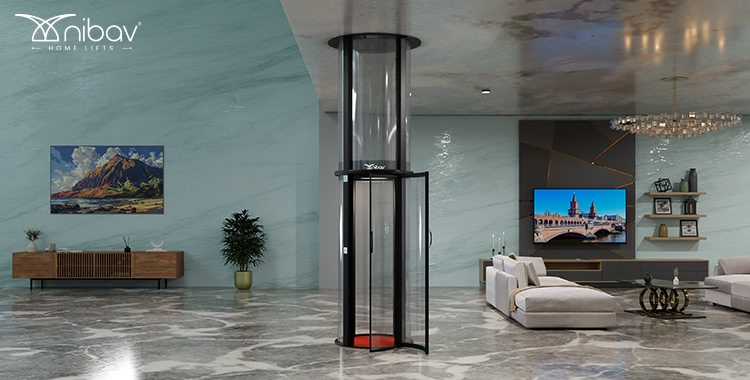
Nibav Malaysia offers a range of air-driven, pitless home elevators specifically designed to work within existing homes — no pit, no machine room, no structural modifications. The technology is pneumatic: the elevator moves through a self-supporting transparent cylinder using air pressure differentials, requiring only a flat floor surface and a single-phase electrical connection. Installation typically completes in 4–5 working days with zero disruption to the household.
Every model in the Nibav range is designed with elderly users in mind. The Series III Standard, starting from MYR 89,900*, is the most compact option — ideal for smaller homes with a single senior user who needs safe, reliable floor-to-floor access. Its 360-degree panoramic cabin eliminates the claustrophobic feeling of enclosed lifts, which many elderly users find distressing.
The Series III Max steps up to a 1160mm internal cabin, comfortably accommodating a wheelchair user and an attendant — essential for families where mobility aids are already in use or anticipated in the future. For homeowners seeking a blend of accessibility and sophisticated design, the Series IV Standard introduces AI and voice command readiness, making operation effortless even for seniors who are not comfortable with technology.
The Series IV Max adds greater capacity and premium metallic interior finishes, designed for luxury homes where aesthetics matter as much as function. At the top of the range, the Series V Standard and Series V Max introduce the SmartConnect system — emergency communication built directly into the touchscreen, so a senior user can call for help at any time without a separate device. The Series V Max also features AutoGlide sensor doors that open automatically as the user approaches, removing the need to press any button — a small detail that makes an enormous difference for someone with reduced dexterity.
Across all models, Nibav’s safety framework is comprehensive: automatic emergency descent during power failures, triple-layer door locking, Smart Overload Alert, Child Safety Lock, and 30-minute auxiliary power for lights, ventilation, and communication. Every elevator carries TÜV NORD certification, meeting European safety standards. The CoreShield warranty on Series V models covers the motor and vacuum seal for 25 years — giving families genuine, long-term peace of mind.
The Financial Case: Home Elevator Cost vs. Long-Term Value
The home elevator cost question is best understood in context. Nibav’s range starts at MYR 89,900* for the Series III Standard — a fraction of what traditional elevator installation costs in Malaysia when shaft construction is included. But the more meaningful comparison is against the cost of not installing one. A single serious fall-related hospitalisation, rehabilitation programme, or long-term care transition can cost far more than the elevator itself, and none of those outcomes can be undone.
A home elevator also adds measurable resale value to the property, particularly in a market where multi-generational living and accessibility are becoming increasingly important to buyers. It is not just a safety investment — it is a financial one.
Give your parents the independence and safety they deserve — in the home they love. Book a free Nibav consultation today at nibavlifts.my
Frequently Asked Questions
Q1. What is the home elevator cost for an elderly-friendly model in Malaysia?
Nibav’s home elevators for elderly users start at MYR 89,900* for the Series III Standard. Mid-range models like the Series IV Standard begin at MYR 119,900*, and premium Series V models are priced on consultation. All prices are starting rates that may vary with customisation and floor count.
Q2. Can a home elevator be installed in an existing home without major construction?
Yes. Nibav’s pitless, self-supporting elevators require no pit excavation, no machine room, and no structural modifications. They need only a flat floor surface and a single-phase power point. Installation is typically complete in 4–5 working days with minimal disruption to household routines.
Q3. Are home elevators safe for elderly users who may be alone in the house?
Absolutely. Every Nibav elevator includes automatic emergency descent, backup power systems, triple-layer door locking, and built-in emergency communication (SmartConnect on Series V). The system is designed to operate safely without any intervention from the user in the event of a power failure or emergency.
Q4. Which Nibav model is best for a senior with a wheelchair?
The Series III Max, Series IV Max, and Series V Max all feature cabin diameters sufficient for a wheelchair user accompanied by an attendant — 1160mm to 1240mm internal diameter. The Series V Max also includes GlideWide automatic sensor doors for the easiest possible access.
Q5. Can my elderly parents learn to use the elevator easily?
Yes. Nibav’s VividTouch display (Series IV and V) features a large, bright touchscreen with clear floor controls. The Series V models add voice command readiness and AutoGlide automatic doors, so the system can be operated with minimal physical interaction — ideal for seniors with limited dexterity.
Q6. Does installing a home elevator affect property value?
Yes, positively. Malaysian property agents consistently report that premium home elevators increase buyer appeal and resale value, particularly in the multi-generational and luxury residential segments. A Nibav elevator adds both practical value and lifestyle prestige to any multi-storey property.