
 By Nadia Khalis on June 10, 2026 at 5:22 am |



Top 10 Questions I Get Asked Most About Home Elevators in Malaysia That Could Save You Time and Money
After years of consulting with Malaysian homeowners on home elevator choices, the same questions come up again and again. Not because people have not tried to find answers — but because most of what is available online is either too technical, too vague, or written for markets with completely different building norms, cost structures, and lifestyle realities.
This article answers the ten questions I am asked most frequently, honestly and completely — covering cost, installation, safety, suitability, and the differences between models. By the time you finish reading, you will know more about home elevators in Malaysia than most people who have already bought one.
Table of Contents
- 1. How much does a home elevator cost in Malaysia?
- 2. Does a home elevator require a pit or machine room?
- 3. How long does installation take?
- 4. Which is the best residential elevator for a Malaysian home?
- 5. Is a home elevator safe for everyday family use?
- 6. Can I install a home elevator in my existing home without major renovation?
- 7. What is the smallest home elevator available in Malaysia?
- 8. Are home elevators suitable for wheelchair users?
- 9. How energy-efficient is a home elevator, and what are the running costs?
- 10. Can a Nibav home elevator be moved if I relocate?
1. How much does a home elevator cost in Malaysia?
This is always the first question, and the answer depends on which type and model you are considering. For Nibav’s air-driven home elevators — the most popular category for Malaysian residential use — prices start at MYR 89,900 for the Series III Standard. The Series III Max starts at MYR 119,900, the Series IV Standard at MYR 119,900, and the Series IV Max at MYR 146,900. Series V Standard and V Max pricing is available on consultation.
The critical context: these prices include a self-supporting, pitless installation that requires no shaft construction. Traditional elevator installations — which require a concrete shaft, pit, and machine room — can cost MYR 150,000 to MYR 300,000 before you account for the construction work. When comparing home elevator cost in Malaysia, always ensure you are comparing the complete cost, not just the elevator unit itself.
2. Does a home elevator require a pit or machine room?
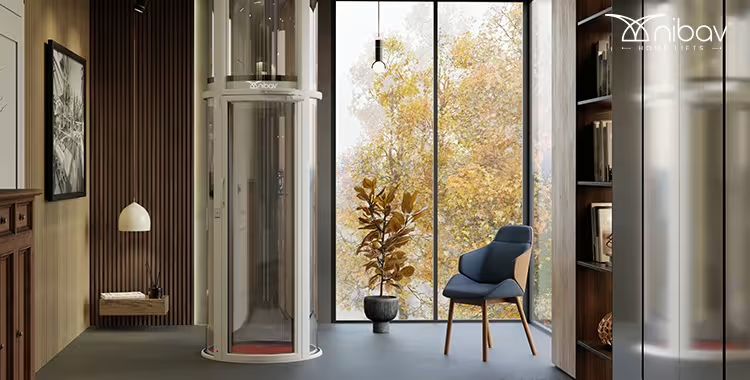
Traditional elevators do — but Nibav’s air-driven models do not. Every model in the Nibav range is completely pitless and self-supporting. They require no excavation beneath the ground floor, no dedicated machine room, and no reinforced concrete shaft. They stand on your existing floor surface, supported entirely by their own structure. This is the single most important practical advantage they offer for Malaysian homeowners installing into existing properties.
3. How long does installation take?
For a Nibav home elevator installed in a prepared site — meaning a flat floor surface and an accessible electrical connection are ready — the installation typically completes in 4 to 5 working days. The elevator arrives as pre-engineered modular components that pass through standard doorways. There is no heavy machinery on site, no structural work in progress, and no weeks of waiting. Your household continues normally throughout. This is categorically different from traditional elevator installations, which can take months.
4. Which is the best residential elevator for a Malaysian home?
There is no single best model — it depends on your home, your family, and your priorities. For compact homes or as a first elevator for a senior, the Series III Standard offers the smallest footprint and most accessible entry price. For wheelchair accessibility, the Series III Max or larger models are recommended. For technology-forward households, the Series IV Standard with AI and voice integration delivers the best smart home experience at mid-range pricing. For the most comprehensive combination of luxury, space, technology, and safety, the Series V Max — with AutoGlide sensor doors, SmartConnect emergency communication, and a 1240mm wheelchair-accessible cabin — is the definitive answer.
5. Is a home elevator safe for everyday family use?
Absolutely — and in several meaningful ways, Nibav’s air-driven elevators are safer than traditional alternatives. Because there are no cables to fray or hydraulic seals to fail, the most common mechanical failure modes of conventional elevators do not apply. Every Nibav model includes: automatic emergency descent during power failures, triple-layer door locking that prevents any movement unless all doors are secured, Smart Overload Alert, 30-minute auxiliary power for lighting and emergency communication, and TÜV NORD certified safety compliance. The safest home elevator is one where safety is built into the technology itself — not just added as an afterthought.
6. Can I install a home elevator in my existing home without major renovation?
Yes — and this is perhaps the most common misconception about home elevators in Malaysia. Most homeowners assume that installing an elevator means months of construction and significant structural disruption. With Nibav, the opposite is true. The self-supporting design requires no structural changes to walls, floors, or ceilings. No civil engineering is required. The footprint is precisely the diameter of the cylinder — nothing more. If you have the floor space and a single-phase power connection, you have everything you need.
7. What is the smallest home elevator available in Malaysia?
The Nibav Series III Standard has an external diameter of 935mm — roughly the footprint of a large armchair. Its internal cabin diameter is 749mm, and it is CE certified and TÜV NORD compliant. It is the most compact full-featured home elevator available from Nibav Malaysia, and it installs in 4 to 5 working days. For homeowners with genuinely tight floor plans, this is the starting point of the conversation.
8. Are home elevators suitable for wheelchair users?
Several models in the Nibav range are specifically designed for wheelchair accessibility. The Series III Max (1160mm internal cabin), Series IV Max (1240mm), and Series V Max (1240mm) all accommodate a wheelchair user alongside an attendant. The Series V Max adds GlideWide automatic sensor doors — the widest entry in its class — and AutoGlide approach-sensing door operation, making wheelchair access as seamless as possible. For homes where wheelchair accessibility is a current or anticipated need, these are the models to consider.
9. How energy-efficient is a home elevator, and what are the running costs?
Nibav’s air-driven elevators are among the most energy-efficient residential elevator technologies available. Power is consumed only during the ascent — the descent uses natural air pressure equalisation and requires no electricity. For typical household usage — multiple trips daily — monthly energy costs are modest compared to other household appliances. Combined with the low maintenance requirements of the pneumatic system (no cables, no hydraulic oil, no complex gear systems), the long-term running costs are genuinely low. The Series V’s CoreShield warranty also covers the motor and vacuum seal for 25 years, eliminating a major potential maintenance expense.
10. Can a Nibav home elevator be moved if I relocate?
Yes — and this is a feature that surprises most people, because it is so different from how traditional elevators work. Because Nibav’s elevators are self-supporting and installed without permanent structural integration into the building, they can be deinstalled and reinstalled in a new property. Your elevator investment moves with you. This changes the financial calculus significantly: rather than a fixed infrastructure cost that stays with the building when you sell, it is a relocatable asset that continues serving your family wherever you live.
These ten questions cover the majority of what Malaysian homeowners need to know before making a home elevator decision. But every home is different, and the best advice is always specific advice — tailored to your floor plan, your family’s needs, and your long-term plans.
Ready to stop wondering and start knowing? Book a free Nibav home assessment at nibavlifts.my — our certified consultants will answer every question for your specific situation.

Zara Humaira Fatin
This article answers many important questions about choosing a home elevator. I especially appreciate the clear information about safety, installation, and space requirements. Very helpful for homeowners!
Rayyan Muaz Firdausi
A very informative guide for anyone planning to install a home lift in Malaysia. Understanding the important factors before making a decision makes the whole process much easier.
Tan Wei Jian
I like how this article explains the common questions homeowners may have before purchasing an elevator. The practical information about installation and features is particularly useful.
Farah Nadia Ismail
I appreciate how this blog covers the important things to know before installing a home lift. It is useful for families planning to make their homes more comfortable and accessible.
Lee Kah Mun
Very helpful article! Learning about elevator safety, maintenance, and installation beforehand can help homeowners choose a suitable solution for their properties.