 By Nadia Khalis on June 17, 2026 at 10:09 am |

Space-Saving Domestic Lifts for Compact Homes: What You Need to Know
Your home has two floors. The stairs work fine — for now. But every time your mother grips the banister a little harder, every time your knees remind you of the distance between the ground floor and your bedroom, the question surfaces: is there a better way? The answer is yes — but the assumption that home lifts require major construction has kept most Malaysian homeowners from ever exploring it.
The image of traditional elevators — deep pits, machine rooms consuming an entire room, weeks of dust and workers — is not the reality of residential domestic lifts. That picture belongs to an older generation of technology. The frustration is that this outdated assumption is still the first thing most people think of, and it stops the conversation before it starts.
Today, space-saving domestic lifts are designed specifically for compact Malaysian homes. They arrive pre-engineered, installed quietly in under a week, and fit into a space roughly the size of a wardrobe corner. This guide tells you everything you need to know — how they work, what they cost, where they fit, and why thousands of Malaysian homeowners are already living with one.
Table of Contents
What Makes a Home Lift Truly Space-Saving?
Not every lift marketed as compact genuinely delivers on the promise. Three engineering features separate a truly space-saving domestic lift from one that simply occupies less floor area than a commercial elevator:
- No pit and no machine room: Traditional lifts require a pit below the ground floor and a machine room above or beside the shaft. Modern pneumatic lifts contain the entire mechanism within a self-supporting cylinder — no excavation, no dedicated room, no structural compromise.
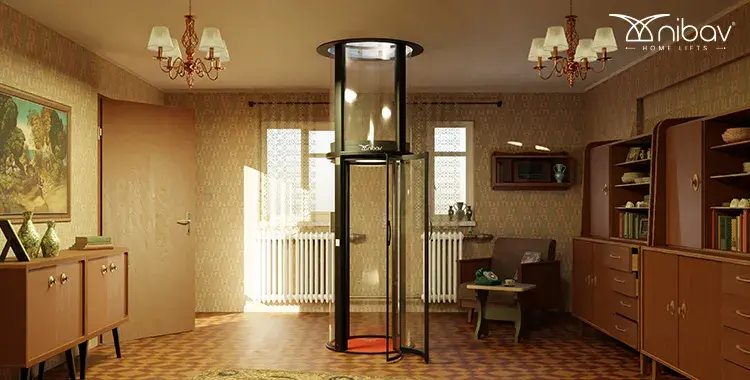
- Compact footprint: The best small home lifts in Malaysia require as little as 1,000 mm of clear space. The external cylinder diameter sits as 933 mm for Standard models — fitting naturally into stair voids, hallway corners, and beside existing staircases.
- High Return of Space (ROS): ROS measures how much of the lift’s floor footprint comes back as a usable cabin interior. Leading compact lifts achieve 72% to 77% ROS — meaning very little of your precious floor area is lost to the mechanics.
When all three are present, you have a lift that genuinely works in a compact Malaysian home — not one that requires the home to be redesigned around it.
Who Benefits Most from a Compact Lift for Home Use?
The demand for small home lifts in Malaysia cuts across a much wider demographic than most people assume. These are the households where a domestic lift makes the most measurable difference:
Multi-generational families: Where elderly grandparents share a home with younger family members, a domestic lift eliminates daily stair risk for the most vulnerable household members while preserving independence and dignity.
Homeowners aged 50 and above: Planning ahead for declining mobility is not pessimistic — it is responsible. A compact home lift installed today becomes indispensable within a decade.
Families with young children: Carrying a sleeping toddler or a heavy pram between floors is a daily physical strain. A lift removes it entirely.
Homeowners in renovation mode: Those upgrading a property — whether for personal use or resale — find that adding a domestic lift during renovation is the most cost-efficient time to do so.
Wheelchair users and their families: Max models with 1,240 mm internal diameter and 240 kg capacity are purpose-built for wheelchair access with an attendant — a life-changing upgrade for mobility-impaired residents.
Where Do Small Home Lifts Actually Fit in Malaysian Properties?
This is the most practical question prospective buyers ask — and the most frequently underestimated. Here is where compact domestic lifts are most commonly and successfully installed across Malaysian homes:
Stair Voids
The space beneath or alongside a staircase is the most natural installation location in a two or three-storey terrace house. The stair void is already a structurally defined vertical channel — adding a lift cylinder here requires minimal additional disruption and preserves the majority of the home’s living area.
Corner Spaces in Living or Dining Areas
In semi-detached homes and larger townhouses, a corner of the ground-floor living area can accommodate a compact lift cylinder with a 1,000 mm clear space requirement. The 360-degree transparent cabin actually enhances the visual openness of the surrounding space rather than reducing it.
Lightwells and Atrium Spaces
Some Malaysian terrace homes and linked villas incorporate internal lightwells or atrium spaces that are largely decorative. These are ideal lift locations — the cylinder replaces unused vertical space with functional, permanent value.
Balcony or External Addition
Where internal space is genuinely constrained, a domestic lift can be added as an external glass structure on a rear or side elevation — a feature that becomes a striking architectural addition rather than an afterthought.
Domestic Lifts in Malaysia: Real Pricing Across the Range
The home lift cost question deserves a direct, honest answer. Here is what Malaysian homeowners can realistically expect to pay for a compact, air-driven domestic lift in 2026:
- Entry-level compact lift (Series III Standard): From MYR 69,900* — includes installation, no civil construction required, and TÜV NORD certified safety systems.
- Mid-range with smart features (Series IV Standard): From MYR 109,900* — adds voice and app control readiness, frameless doors, advanced suspension, and 24+ finish options.
- Premium compact model (Series V Standard): From MYR 119,900* (G+1) — auto-opening doors, HeartLine personalised engraving, SkyMark ceiling, VividTouch display, and 25-year CoreShield warranty.
- Wheelchair-accessible Max models: From MYR 136,900* — wider 1,240 mm cabin, 240 kg capacity, same installation simplicity.
The prices listed are starting prices for the lift and standard installation. Final pricing may vary based on the site requirements, and customisation options.
Safety Features Every Compact Home Lift Should Include
For a lift serving elderly residents, young children, or mobility-impaired users in a compact home, safety features are non-negotiable. These are the standards every reputable domestic lift should meet:
- Emergency descent system: During power interruptions, the cabin automatically lowers to the nearest floor — gravity-powered, requiring no battery or external power source.
- 30-minute battery backup: Maintains cabin lighting and ventilation for up to 30 minutes during outages — essential in Malaysian homes where power interruptions occur.
- Triple-layer door locking: The cabin cannot move until all doors are confirmed fully closed and secured — protecting against accidental departure.
- Smart Overload Alert: Prevents operation if the weight limit is exceeded — protecting both the mechanism and its occupants.
- Child safety lock: Restricts unsupervised use by young children — a standard requirement in family homes.
- TÜV NORD certification: International safety certification confirms the lift has been independently tested against rigorous European performance standards.
A compact lift that checks all six boxes is a genuine long-term asset. One that cuts corners on any of them is a liability — regardless of how small and elegant it looks in the corner of your home.
Space-saving domestic lifts have arrived at a point where the technology, the pricing, and the installation process all align in favour of the Malaysian homeowner. The home no longer needs to be large to have a lift. The lift needs to be designed for the home — and the best ones now are. If you have been wondering whether your property is suitable, the most useful first step is a free site feasibility assessment. Most two-storey Malaysian properties qualify. Most homeowners are surprised by how straightforward the process is when they finally begin it.
Frequently Asked Questions
Q1: What is the smallest space required for a domestic lift in Malaysia?
The most compact models require as little as 1,000 mm (1 metre) of clear floor space. The external cylinder diameter is 933 mm for Standard models — fitting into stair voids, hallway corners, and beside existing staircases in most Malaysian terrace homes and townhouses.
Q2: Do small home lifts in Malaysia need a pit or machine room?
No. Residential air-driven domestic lifts are entirely self-supporting and require no pit excavation, no machine room, and no structural reinforcement. Only a circular floor opening at each level served is required, which is carried out by the installation team.
Q3: How long does it take to install a compact lift for home use?
Installation is completed in 4 to 5 working days on a prepared site. The pre-engineered modular components pass through standard doorways and are assembled on-site without heavy construction, dust, or disruption to the household.
Q4: What is the starting price for a domestic lift in Malaysia?
Air-driven domestic lifts in Malaysia start from MYR 69,900*, including installation, with no additional civil construction costs. The total investment is significantly lower than traditional hydraulic elevators when all costs are honestly compared.
Q5: Are compact home lifts safe for elderly users in Malaysia?
Yes. Leading models include emergency descent, triple-layer door locking, smart overload protection, 30-minute battery backup, child safety lock, and TÜV NORD European safety certification — providing comprehensive protection for elderly and mobility-impaired users in daily residential use.