 By Nadia Khalis on June 15, 2026 at 4:19 am |

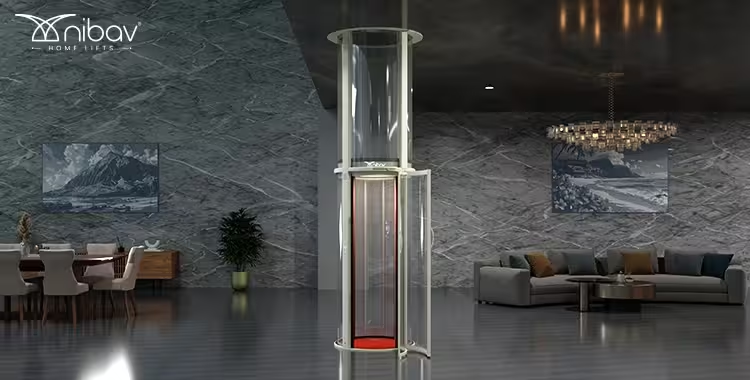
Why Pneumatic Elevators Are Perfect for Compact Homes
You have been staring at that staircase for years. Maybe it was fine when you were younger, when the kids were small, or before your parents moved in. But now, every trip up and down feels like a small negotiation — between comfort and inconvenience, between what your home is and what it needs to be.
You have thought about a home elevator. But then the practical questions kick in. Will it take too much space? Does my home have room for a shaft? Will the installation tear the house apart? And what exactly is the home elevator cost going to look like?
Here is the thing most people do not realise: the elevator you have been imagining — the one that requires a concrete shaft, a pit beneath the floor, and a machine room on the roof — is not the only option. In fact, for compact Malaysian homes like yours, it is probably the worst option.
The right choice, almost certainly, is a pneumatic home elevator. And by the end of this article, you will understand exactly why.
Table of Contents
What Is a Pneumatic Home Elevator?
A pneumatic home elevator — also called a vacuum elevator or air-driven home lift — is a residential elevator that moves through a transparent, self-supporting cylinder using air pressure differentials. There are no cables, no hydraulic oil, no counterweights, and no mechanical pit.
The science is elegantly simple. When you travel upward, a vacuum pump reduces air pressure above the cabin, and the higher pressure below pushes the cabin up. When descending, the pressure equalises through a controlled valve, and the cabin glides smoothly down using gravity. The whole system is powered by a single-phase electrical connection — the same kind your air-conditioner uses.
For compact homes, this technology is transformative. It removes every structural barrier that has historically made home elevator installation impractical for residential properties in Malaysia.
Why Compact Homes and Pneumatic Elevators Are a Perfect Match
No Pit. No Machine Room. No Structural Compromise.
Traditional elevators demand a pit dug beneath the ground floor slab — typically 300–600mm deep — plus a dedicated machine room either at the top of the shaft or in an adjacent utility space. For a compact home, this is not just inconvenient; it is often structurally impossible or prohibitively expensive.
A pneumatic vacuum elevator is entirely self-supporting. It stands on your existing floor surface, requires no excavation, and needs no machine room. The footprint it occupies is exactly the footprint of the cylinder — nothing more. This is the fundamental reason why compact homes across Malaysia are increasingly choosing this technology over any alternative.
The Footprint Is Smaller Than You Think
One of the most persistent myths about home elevators is that they consume enormous amounts of floor space. With a pneumatic compact home elevator from Nibav, the reality is the opposite. Nibav measures efficiency using a Return of Space (ROS) metric — the percentage of the lift’s external footprint that is returned as usable interior cabin space.
- Nibav Series III Standard: External diameter 935mm — roughly the floor space of a large armchair
- Nibav Series IV Standard: External diameter 933mm, internal cabin 830mm, ROS 72%
- Nibav Series V Max: External diameter 1363mm, internal cabin 1240mm, ROS 77%
Compare this to a traditional lift shaft which adds surrounding walls, support structure, and service access space — consuming far more of your home’s valuable floor plan. A Nibav pneumatic elevator takes less room and gives more of it back to you as usable cabin space.
Installation That Respects Your Home
For a compact home, any installation process that involves weeks of construction, noise, dust, and disruption is simply not acceptable. Nibav’s modular vacuum elevators arrive as pre-engineered components that pass through standard doorways. There is no heavy machinery, no excavation crew, and no structural engineer required on site.
Most installations are completed in just 4 to 5 working days. Your home remains liveable throughout. Your floors, walls, and ceilings are untouched. And when the technicians leave, what you have is a fully operational, beautifully finished elevator — not a construction site.
Energy Efficiency Built Into the Physics
In a compact home, running costs matter. Pneumatic home elevators only consume electricity during the ascent — the descent uses natural air pressure at zero energy cost. This makes them significantly cheaper to operate than hydraulic or traction alternatives. For daily household use across multiple years, the savings are real and measurable.
The Full Nibav Range: A Pneumatic Elevator for Every Compact Home
Nibav Malaysia offers six vacuum elevator models, all built on the same core benefits:
- No pit, no machine room
- Air-driven technology
- Panoramic glass cabin
- Compact, space-saving design
Here’s how to choose the right model for your home:
Series III Standard — From MYR 69,900*
- Most compact model (935mm footprint)
- Ideal for 2–3 storey homes
- Carries 1–2 passengers
- Quick 4–5 working days installation
Best for: Small homes needing a simple, space-saving lift
Series III Max — From MYR 99,900*
- Larger 1160mm internal cabin
- 240 kg load capacity
- Wheelchair-friendly operation
- Compact, pitless setup
Best for: Families & accessibility needs
Series IV Standard — From MYR 109,900*
- AI & voice command ready
- Frameless doorway, screw-free panels
- Three-layer-door-lock safety
- Upto 13500 mm travel height
Best for: Homes prioritizing design + technology
Series IV Max — From MYR 136,900*
- Wider cabin with 240 kg capacity
- Premium metallic interiors
- Designed for luxury villas
- No extra structural space required
Best for: Luxury homes needing space + style
Series V Standard — From MYR 119,900*
- HeartLine personalization (custom engraving)
- SkyMark illuminated ceiling
- SmartConnect touchscreen communication
- Zerotrace – clean design
Best for: High-end smart homes with personalization
Series V Max — From MYR 149,900*
- 1240mm internal cabin
- GlideWide wide-entry doors
- AutoGlide sensor doors
- VividTouch smart display
Best for: Maximum luxury + accessibility in compact homes
Safety That Works Quietly in the Background
The concern that compact home elevator buyers most often raise — after cost and space — is safety. Is an air-driven elevator as safe as a traditional one? The honest answer is: it is safer in several meaningful ways.
Because there are no cables to fray, no hydraulic seals to rupture, and no counterweights to malfunction, the mechanical failure modes of traditional elevators simply do not apply. And the safety systems built into every Nibav model are comprehensive:
- Emergency Descent — automatic, controlled lowering to the nearest floor during any power failure
- Triple-Layer Door Lock System — the elevator will not move unless every door is fully secured
- Smart Overload Alert — automatic shutdown if weight exceeds safe operating limits
- Brake 3.0 (Series V) — dual-layer braking for instant, reliable stops
- 30-Minute Auxiliary Power — lights, ventilation, and emergency communication remain active
- Child Safety Lock — prevents unauthorised use
- TUV NORD Certification — European safety standard compliance across the range
These features are not optional upgrades. They are standard equipment on every Nibav pneumatic elevator, from the most affordable Series III Standard to the flagship Series V Max.
Your compact home deserves an elevator that works with its design — not against it. Book a free site consultation with Nibav Malaysia and discover which model is right for you. Visit nibavlifts.my
Frequently Asked Questions
Q1. What is a pneumatic or vacuum home elevator?
A pneumatic (vacuum) home elevator uses air pressure differences to move the cabin inside a transparent, self-supporting cylinder. It does not use cables, pulleys, or hydraulic systems, making it one of the most compact and low-maintenance elevator options for modern homes.
Q2. How much does a compact home elevator cost in Malaysia?
Compact home elevators typically start from around MYR 69,900 and can go up to MYR 136,900 or more, depending on the model and features. Compared to traditional elevators that require shaft construction, pneumatic lifts are often more cost-effective overall.
Q3. Do pneumatic elevators require a pit or machine room?
No, pneumatic elevators are completely self-supporting and do not require a pit, machine room, or major structural changes. They only need a flat surface and a standard electrical connection, making them ideal for both new and existing homes.
Q4. Are pneumatic elevators safe for daily use in homes?
Yes, they are designed with multiple safety features such as automatic emergency descent, door safety locks, overload protection, and backup power systems. These features ensure safe and reliable operation for everyday residential use.
Q5. Which model is best for a compact or duplex home?
For smaller homes, the Series III Standard is a space-saving option. For families or users needing more room, the Series III Max offers a larger cabin while still maintaining a compact installation footprint.
Q6. How long does it take to install a pneumatic home elevator?
Installation usually takes 4 to 5 working days once the site is ready. Since no heavy construction is required, the process is quick, clean, and causes minimal disruption to your daily routine.