 By Nadia Khalis on May 28, 2026 at 5:28 am |



Why a Small House Lift Is Perfect for Compact Living Spaces
When your home is compact, every decision counts. Every square foot matters. Every purchase is weighed against the space it takes up. And for most Malaysian homeowners in terrace houses, townhouses, and modest duplexes, the idea of a home lift feels like something reserved for mansions — impressive in concept, impossible in practice.
The reality, though, is far more encouraging. Traditional elevator myths – machine rooms, deep pits, weeks of disruptive construction – no longer apply to every lift solution. A new generation of small house lifts is rewriting the rules entirely, and they are built precisely for homes like yours.
If you have ever dismissed the idea of a house lift because your home is ‘too small’, this article is for you. A compact, space-saving home lift not only fits, but it also transforms how your home feels and functions without taking up the space you’re trying to protect. From how the technology works to what it realistically costs and where it can be installed, here is everything you need to know.
Table of Contents
- Who Actually Needs a Small House Lift in Malaysia?
- How a Space-Saving Home Lift Actually Works
- Compact House Lift Dimensions: Will It Fit in Your Home?
- Lift for Homes in Malaysia: What Does It Cost?
- Design Matters: A Compact Lift That Enhances, Not Disrupts
- Safety Features Built for Every Member of the Family
- Frequently Asked Questions
Who Actually Needs a Small House Lift in Malaysia?
The answer might surprise you. Small house lifts are not just for luxury homes or elderly residents. The target audience is broader and more relatable than most people expect. A remarkably diverse group of homeowners is driving the demand for compact home lifts in Malaysia today:
- Young families in two-storey terrace homes who want convenience and child safety between floors
- Middle-aged homeowners planning ahead for ageing parents or their own retirement
- Homeowners with family members recovering from surgery or managing a disability
- Compact-home owners in Klang Valley, Penang, and Johor Bahru who want premium features without sacrificing floor space
- Investors and property owners looking to increase the resale appeal of a mid-range residential property
They all want a lift that fits their home, not one that needs a rebuild. As Malaysian homes grow vertically within tighter land boundaries, the demand for lifts that complement rather than compromise the home’s design will only continue to rise.
How a Space-Saving Home Lift Actually Works
Modern compact house lifts use pneumatic (air-driven) technology rather than cables, hydraulic fluid, or heavy machinery. Understanding how it works is key to understanding why it fits where traditional lifts cannot.
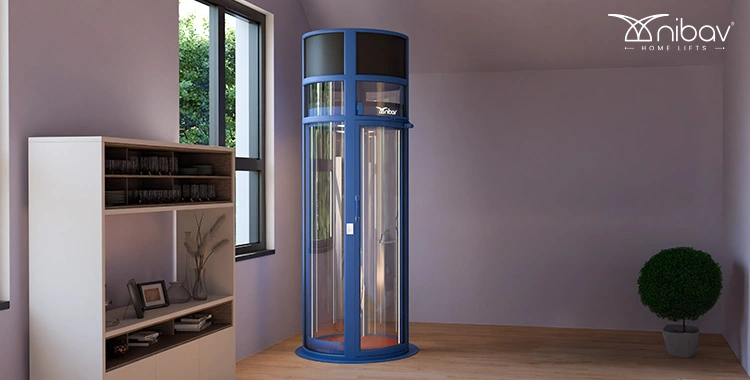
The cylindrical cabin sits within a transparent polycarbonate shaft. Air pressure differentials above and below the cabin control its movement — upward travel uses a small vacuum pump, while descent relies on gravity and controlled air release. The entire system is self-contained within the cylinder itself. There are no cables to run through walls, no hydraulic lines to thread through floors, and no separate machine room housing a motor.
What does this design mean for a compact home?
- No pit required beneath the ground floor — saves 300 to 500 mm of depth and avoids slab breakage
- No machine room required above or beside the shaft — saves an entire room’s worth of valuable floor space
- Minimal clear space required — the Nibav Series III Standard needs only 1,010 mm
- No structural reinforcement needed — the shaft is fully self-supporting
- Installation completed in 4 to 5 working days with zero heavy construction noise or mess.
In short: you get a full home lift, and your home stays intact. The only physical change to your existing structure is a circular floor opening for each level the lift serves — a targeted, controlled process that takes hours, not weeks.
Compact House Lift Dimensions: Will It Fit in Your Home?
This is the most practical question – and the answer is almost always yes. Let’s look at the actual footprint of Nibav’s compact models:
- Nibav Series III Standard: 935 mm external cylinder diameter, 1,010 mm clear space required
- Nibav Series IV Standard: 933 mm external cylinder diameter, 1,000 mm clear space required
- Nibav Series V Standard: 933 mm external cylinder diameter, 1,000 mm clear space required
To put the figures in perspective: roughly one square metre of floor space is all you need. Common installation locations in compact Malaysian homes include stair voids, corner spaces in the living area, mezzanine access points, and lightwells. Often, homeowners are surprised to discover that the space they assumed was too small is more than adequate.
Nibav uses the Return of Space (ROS) metric to measure the amount of usable cabin space returned from the lift’s total footprint. For the Series III and Series IV Standard models, the ROS is 72%—meaning the cabin delivers 72% of the floor area consumed as a usable interior. For the Max models, the figure rises to 77%. These are among the highest space-efficiency ratios of any home lift available in Malaysia.
Lift for Homes in Malaysia: What Does It Cost?
For homeowners weighing a compact house lift against other home improvement investments, the pricing landscape in Malaysia looks like this:
- Nibav Series III Standard (entry-level): From MYR 89,900*
- Nibav Series IV Standard (advanced features): From MYR 119,900*
- Nibav Series V Standard (premium): From MYR 119,900*
Importantly, these prices include installation — and because no civil construction is required, you avoid an additional MYR 30,000 to MYR 80,000 in contractor fees that conventional elevators typically demand. There is no separate bill for pit excavation, no architect fees for structural redesign, and no extended construction timeline that forces your family out of routine.
Ongoing costs are also significantly lower. Air-driven lifts consume electricity only on the way up, draw no power during descent, and require approximately 90% less maintenance than hydraulic alternatives. With fewer moving parts and no lubrication required, the long-term cost of ownership is well below that of traditional elevator systems. For a compact home with a careful budget, this total picture is difficult to match.
Design Matters: A Compact Lift That Enhances, Not Disrupts
A practical concern for compact home owners is whether a lift will look out of place. Nibav’s answer is a confident no — and the design rationale backs it up.
The cylindrical glass design is purposely beautiful. The transparent shaft brings light into dark corridors, the 360-degree cabin view prevents any sense of enclosure, and the customisable finishes—upto 24 options, depending on the series— mean the lift complements rather than clashes with existing interiors.
For Series V buyers, the customisation goes even further. HeartLine laser engraving on the cabin wall allows you to inscribe your family name or a meaningful message. The SkyMark illuminated ceiling adds an ambient glow that makes the cabin feel like an intentional design feature. ZeroTrace seamless panelling hides every screw and hinge for a flawless interior finish.
In compact spaces, in particular, the optical effect of a glass lift works in your favour: it takes up physical space while visually expanding the area around it. Many homeowners report that the lift makes their home feel larger after installation — not more crowded. Far from being an imposition, a well-chosen compact lift becomes a signature element of the home.
Safety Features Built for Every Member of the Family
Safety is one of the most important considerations for any lift in Malaysian homes, especially in households with children, elderly residents, or mobility-impaired users. Nibav compact lifts come equipped with a comprehensive set of safety systems that leave nothing to chance:
- Child Switch: A dedicated safety lock restricts unsupervised use by young children.
- Smart Overload Alert: The lift automatically refuses to operate if weight limits are exceeded
- Emergency Descent: During a power outage, the cabin descends smoothly to the nearest floor.
- Battery 2.0: Maintains cabin lighting and ventilation for up to 30 minutes during power failures.
- Triple-layer door locking: The cabin will not move until all doors are fully secured.
- TÜV NORD Certification: All Nibav lifts comply with European safety and performance standards.
A small house lift is not a compromise. It is proof that thoughtful engineering and good design can coexist — that a compact home and a luxurious, safe lifestyle are not mutually exclusive. If you have been holding off because of space concerns, consider this your sign to take a second look. With Nibav, your home is more than big enough.
Frequently Asked Questions
Q1: Can a house lift really fit on a small Malaysian terrace or townhouse?
A: Yes. Nibav’s compact lifts require as little as 1,000 mm of clear space, making them suitable for installation in stair voids, corners, or small lightwells found in typical Malaysian terrace homes and townhouses. A free site feasibility check by a Nibav consultant can confirm the best location in your specific home.
Q2: Will a compact house lift damage my home’s structure during installation?
A: No. Nibav lifts are fully self-supporting and require no pit, no machine room, and no structural alterations. Installation involves only minimal making-good work on a flat floor and a standard electrical connection, plus the necessary circular floor openings between levels.
Q3: How much space does a small house lift take in a compact home?
The Series III Standard is the smallest Nibav model. It has an outside cylinder diameter of 935 mm and only needs 1,010 mm of clear floor space. That is roughly equivalent to the footprint of a small wardrobe, making it viable in the majority of Malaysian multi-storey homes.
Q4: What is the starting price for a compact house lift in Malaysia?
A: Nibav’s most affordable space-saving home lift starts from MYR 89,900*, which includes installation. Unlike traditional elevator installations, where these costs can easily add MYR 50,000 to MYR 100,000 to the unit price, there are no extra costs for civil construction, machine rooms, or pit excavation.
Q5: Is a small house lift noisy or disruptive to live with?
A: Not at all. Nibav air-driven lifts operate almost silently. The pneumatic mechanism produces minimal noise during operation, and the built-in acoustic insulation ensures the lift does not disturb daily life, conversations, or sleep — even in open-plan or compact homes where sound travels easily.