 By Nadia Khalis on May 25, 2026 at 6:40 am |



Struggling with Stairs? Why Seniors Need Home Elevators: A Complete Guide to Home Lifts for the Elderly
It starts small. A slight hesitation at the bottom of the staircase. A hand on the wall that was not there last year. Then the bedroom gets moved to the ground floor, because the upper levels feel too far away. And somewhere along the way, the home your family has lived in for decades quietly starts shrinking around the people inside it.
If you recognise this pattern — in your parents, in a spouse, or even in yourself — you are not alone. Across Malaysia, thousands of multi-storey homeowners face this exact situation. The good news: a home elevator for seniors is no longer the complex, expensive, disruptive installation it once was. This guide tells you everything you need to know.
Table of Contents
Why Stairs Become a Crisis — Not Just an Inconvenience
We tend to talk about stair-related falls as accidents. But for aging adults, they are often the predictable outcome of a gradual mismatch between a person’s changing physical capabilities and a home that has not changed at all. Balance deteriorates with age. Muscle strength in the legs declines. Vision may change. Medications can affect coordination. The staircase that was perfectly safe at 45 is a genuinely different proposition at 70.
The Malaysian Medical Association and fall-prevention researchers consistently highlight that home environments — particularly staircases — are among the most common sites of serious injury for older adults. But the data captures only the falls that happen. It cannot measure the fear, the self-imposed restrictions, and the quiet loss of independence that precede them. Many aging adults modify their own behaviour to avoid stairs — skipping meals upstairs, giving up hobbies in upper rooms, gradually retreating from their own homes — long before any fall occurs.
For family members, this creates a particular kind of guilt. You cannot be there all the time. You worry when you leave. The idea of your parents navigating stairs alone weighs on you in ways that are hard to articulate. A home elevator for aging adults resolves this anxiety directly, practically, and permanently.
What Most Guides Miss: The Emotional Dimension
Most online resources about home lifts for the elderly focus almost entirely on technical specifications — dimensions, weight capacity, installation requirements. These things matter, but they miss the more important truth: the decision to install a home elevator is fundamentally an emotional one. It is about preserving dignity. Maintaining independence. Letting a person you love continue to live in their home, on their terms, without the constant reminder that their body is changing.
The right home elevator for seniors does not just transport a person between floors — it returns them to their whole home. Every room becomes accessible again. The balcony. The study. The grandchildren’s playroom upstairs. Life expands again, rather than contracts. That is the real value, and it is one that cannot be captured in a specification sheet.
Why Traditional Options Do Not Solve the Problem
Stairlifts are the most commonly considered alternative, and while they solve part of the problem, they create others. The user must still transfer between a seated position and standing at each floor. They cannot accommodate wheelchairs. They are typically unsightly and can make a home feel more like a care facility than a family residence. And they do nothing for users who use walking frames, rollators, or mobility aids that cannot navigate a stairlift landing.
Traditional home elevators — requiring a reinforced concrete shaft, a pit beneath the ground floor, and a dedicated machine room — are prohibitively disruptive and expensive for most Malaysian homes. Installation can take months and require significant structural work. For a senior already living in the property, this is not just inconvenient; it is often genuinely unsafe during the construction period.
How Nibav Solves This — Completely and Elegantly
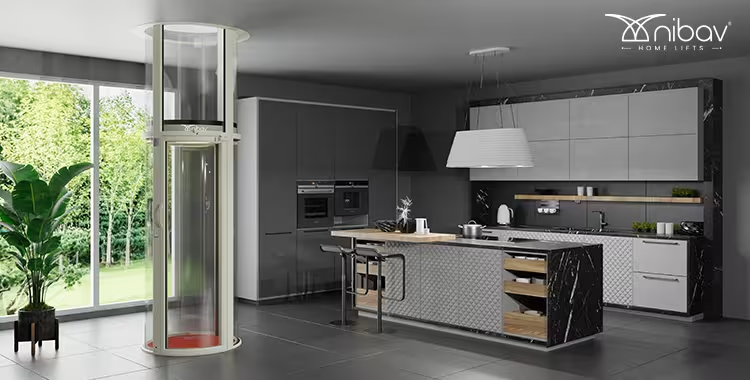
Nibav Malaysia’s range of air-driven home elevators was built specifically to overcome every barrier that has historically made home elevator installation impractical: cost, construction, space, and time. Nibav lifts are pitless, self-supporting, and pneumatically driven — they need no pit, no machine room, and no structural modifications to your home. They install in 4–5 working days and operate on a standard single-phase electrical connection.
For seniors in smaller homes or where space is a primary concern, the Series III Standard (from MYR 89,900) delivers everything essential: a 360-degree panoramic cabin that eliminates claustrophobia, smooth air-driven operation, automatic emergency descent, and a comprehensive safety suite — all within an external footprint of just 935mm. It is the most accessible entry point into safe, dignified home mobility.
Families where a parent uses a wheelchair, walker, or requires assistance will find the Series III Max particularly well suited — its 1160mm internal cabin comfortably fits a wheelchair user and an attendant, and its 240kg capacity handles daily multi-person use with ease. For homeowners who want technology to match design, the Series IV Standard introduces AI and voice command integration, making operation simple and intuitive for seniors who may not be comfortable with touchscreens.
The Series IV Max brings premium metallic interior finishes and expanded capacity to homes where luxury and accessibility are equally important — because the two are not mutually exclusive. And at the pinnacle of the range, the Series V and Series V Max redefine what a luxury home elevator for aging adults can be. SmartConnect places emergency communication directly on the cabin touchscreen — no separate handset to locate in an emergency. AutoGlide sensor doors open as the user approaches. The HeartLine personalisation feature allows a family name or meaningful message to be engraved inside the cabin — a small touch that transforms a piece of engineering into something deeply personal. The CoreShield 25-year warranty on the motor and vacuum seal ensures that this investment serves your family for decades.
Understanding Home Elevator Cost: A Clearer Picture
The home elevator cost question deserves a nuanced answer. Nibav’s range starts at MYR 89,900* — a significant investment, but one that needs to be placed in context. Traditional elevator installations with full shaft construction in Malaysia frequently cost MYR 150,000–300,000 or more, and take months to complete. Stairlifts, while cheaper initially, often require replacement or significant maintenance within a few years and do not offer the same safety, accessibility, or dignity.
When you factor in the prevention of a single serious fall — the hospitalisation, the rehabilitation, the potential need for ongoing care — a Nibav elevator pays for itself in the first year. It also adds demonstrable resale value to your property, making it simultaneously a safety investment and a financial one.
Your family’s safety and independence should never be a compromise. Book your free Nibav consultation today at nibavlifts.my and discover which model is right for your home.
Frequently Asked Questions
Q1. How much does a home elevator for seniors cost in Malaysia?
Nibav’s senior-friendly home elevators start at MYR 89,900* for the Series III Standard. The Series III Max starts at MYR 119,900*, Series IV Standard at MYR 119,900*, and Series IV Max at MYR 146,900*. Series V pricing is available on request. Final costs vary with customisation and number of floors served.
Q2. Can a home elevator be installed without major renovation?
Yes. All Nibav home elevators are pitless and self-supporting — they require no pit, no machine room, and no structural wall modifications. Installation takes 4–5 working days on a prepared site and requires only a flat floor and a standard electrical connection.
Q3. Is a home elevator safe for an elderly person to use alone?
Yes. Nibav elevators include automatic emergency descent, 30-minute backup power, triple-layer door locking, emergency communication (SmartConnect on Series V), and TÜV NORD certified safety systems. They are designed to operate safely without user intervention during any power failure or emergency.
Q4. What is the most suitable model for a senior with limited mobility?
The Series V Max is the most comprehensive option, with AutoGlide automatic sensor doors, a 1240mm wheelchair-accessible cabin, SmartConnect emergency communication, and the widest entry in its class. For budget-conscious families, the Series III Max offers a wheelchair-accessible 1160mm cabin from MYR 119,900*.
Q5. How is a Nibav home elevator different from a stairlift?
A stairlift requires the user to transfer in and out of a seat at each floor, cannot accommodate wheelchairs, and is incompatible with walking frames. A Nibav home elevator carries the user and their mobility aid comfortably between floors in a fully enclosed, safe cabin — with no transfers, no risk of missing a step, and a far more dignified experience.
Q6. Can a Nibav elevator be relocated if we move home?
Yes. Unlike traditional elevators that are permanently integrated into a home’s structure, Nibav’s self-supporting pitless elevators can be relocated to a new property. This makes them a genuinely portable long-term investment, not a permanent structural fixture.