 By Nadia Khalis on May 26, 2026 at 7:07 am |



What Are Compact Air-Driven Elevators and How Do They Work?
You have probably heard the phrase air-driven elevator or pneumatic home elevator and thought it sounded like something from a sci-fi film. But this technology is not futuristic — it is already inside thousands of Malaysian homes, quietly revolutionising the way families move between floors. If you have been wondering what these elevators actually are, how they work, and whether one could work in your home, this is the most complete explanation you will find.
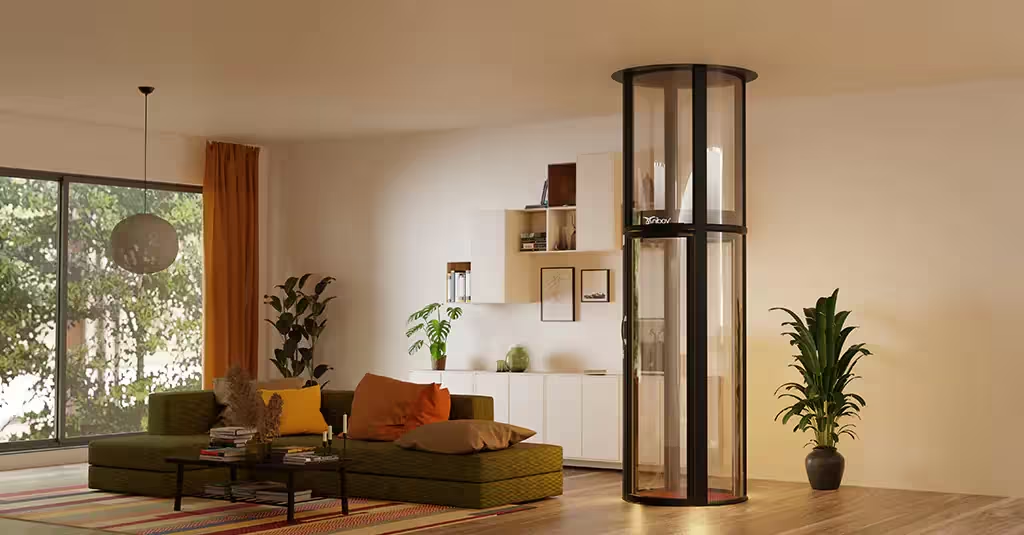
Here is the short answer: a compact air-driven elevator uses air pressure to move a cabin up and down inside a transparent, freestanding cylinder. No cables. No hydraulic oil. No pit. No machine room. Just physics, elegantly applied to one of the oldest problems in home design.
Table of Contents
- The Science Behind Air-Driven Elevators — Simply Explained
- Why the Compact Part Matters for Malaysian Homes
- Installation: The Part That Surprises Everyone
- Every Nibav Model: Which Air-Driven Elevator Is Right for You?
- Maintenance, Longevity, and the True Home Elevator Price Equation
- Frequently Asked Questions
The Science Behind Air-Driven Elevators — Simply Explained
Every pneumatic home elevator operates on the same fundamental principle: differential air pressure. The elevator cabin sits inside a sealed polycarbonate cylinder. Above and below the cabin, air pressure can be controlled independently by a vacuum pump system.
When you want to go up, the pump reduces air pressure in the cylinder above the cabin. The higher air pressure below pushes the cabin upward — think of it like a giant syringe in reverse. When you want to descend, a controlled valve releases air pressure gradually above the cabin, and gravity guides the cabin down smoothly, at a precisely managed speed. The system uses electricity only during the ascent. The descent is powered entirely by natural air pressure — which is why Nibav’s air-driven elevators are among the most energy-efficient residential elevator solutions available in Malaysia.
There are no cables to maintain or replace. No hydraulic seals to check for leaks. No complex gear systems. The mechanical simplicity of the pneumatic system is one of its greatest advantages, translating directly into lower maintenance costs and longer operational life.
Why the Compact Part Matters for Malaysian Homes
The word compact in compact home elevators is not marketing language — it is a precise technical advantage. Traditional home elevators require a reinforced shaft structure surrounding the cabin, a pit below the ground floor, and a machine room either adjacent to or above the shaft. The total footprint consumed by these requirements is dramatically larger than the cabin itself.
Air-driven elevators eliminate all of this. The cylinder is self-supporting, meaning it needs no surrounding shaft walls. There is no pit beneath the floor. There is no machine room. What you see — the transparent cylinder — is essentially all the space the elevator occupies. Nibav measures this efficiency with a metric called Return of Space (ROS), which quantifies how much of the external footprint is returned as usable interior space:
- Series III Standard: 935mm external, 749mm internal cabin — fits in a space smaller than most home armchairs
- Series IV Standard and V Standard: ROS of 72% — over two-thirds of the footprint is liveable cabin space
- Series IV Max and V Max: ROS of 77% — the most space-efficient models in the Nibav range
This matters enormously in Malaysian homes where every square foot of floor space has been thoughtfully allocated. A compact air-driven elevator does not consume your home — it integrates into it.
Installation: The Part That Surprises Everyone
When most homeowners hear elevator installation, they mentally prepare for months of construction. Walls removed, floors broken up, contractors everywhere. The reality with a Nibav compact air-driven elevator is completely different, and consistently the detail that surprises people most.
Nibav’s elevators are delivered as pre-engineered modular components that pass through standard doorways. No heavy machinery. No structural changes to walls, floors, or ceilings. The installation team mounts the cylinder on the existing floor surface, connects the electrical point, runs safety checks, and commissions the unit. The entire process — from arrival of components to a fully operational elevator — typically takes 4 to 5 working days. Your household continues its daily routine throughout.
The only requirements are a flat, level floor surface, a single-phase electrical connection (the same type used by air-conditioning systems), and sufficient ceiling height at each floor level. No civil engineering survey. No structural reinforcement. No weeks of waiting.
Every Nibav Model: Which Air-Driven Elevator Is Right for You?
Nibav Malaysia offers six air-driven home elevator models, each sharing the same core pneumatic technology and pitless installation profile, differentiated by cabin size, capacity, and feature sophistication.
The Series III Standard (from MYR 89,900*) is the entry point — compact, efficient, and designed for households where a single senior or one to two regular users need reliable floor-to-floor mobility. Its 360-degree panoramic polycarbonate cabin is CE certified and provides a comfortably open ride experience that avoids the closed-in feeling of traditional elevators.
The Series III Max (from MYR 119,900*) offers a significantly larger 1160mm internal cabin — wide enough for a wheelchair user and an attendant — at a home elevator price that represents exceptional value for the accessibility it delivers. It is the first choice for families where current or anticipated mobility needs require extra space.
The Series IV Standard (from MYR 119,900*) brings AI and voice command readiness into the pneumatic elevator category. Operate it by voice, app gesture, or touchscreen. The frameless panoramic doorways and screw-free panel finish give it a genuinely luxury aesthetic — this is an elevator that enhances a home rather than merely serving it.
The Series IV Max (from MYR 146,900*) adds a wider cabin, 240kg capacity, and premium metallic interior textures. It is the model for multi-storey villas and luxury duplexes where the elevator is a design statement as much as a functional feature.
The Series V Standard elevates the category further with HeartLine laser cabin engraving, SkyMark illuminated ceiling, SmartConnect emergency communication via touchscreen, VividTouch smart display, and CoreShield 25-year motor and vacuum seal warranty. These are not incremental upgrades — they represent a genuinely different ownership experience.
The Series V Max takes all of this and adds the GlideWide automatic sensor doors — the widest entry in its class — AutoGlide approach-sensing door operation, and a 1240mm cabin that is fully wheelchair-accessible with room for an attendant. For families who want the most capable, most refined, and most future-proof air-driven home elevator in Malaysia, the Series V Max is the answer.
Maintenance, Longevity, and the True Home Elevator Price Equation
One of the most underappreciated advantages of pneumatic elevator technology is what happens after installation. Traditional elevator systems — cables, hydraulic circuits, counterweights — require regular professional maintenance, parts replacement, and periodic safety inspections that add up significantly over time. Air-driven elevators have dramatically fewer moving parts. There are no cables to inspect, no oil to change, no complex gear systems to service.
Nibav’s maintenance requirements are minimal by design. And with the CoreShield warranty covering Series V motors and vacuum seals for 25 years, the long-term cost picture is genuinely compelling. When evaluating home elevator price, the full equation must include installation, energy costs, maintenance, and longevity — and on every one of these dimensions, a Nibav air-driven elevator compares favourably.
Curious about which Nibav air-driven elevator fits your home? Get a free site assessment from our certified consultants. Visit nibavlifts.my today.
Frequently Asked Questions
Q1. What is the price of a compact air-driven home elevator in Malaysia?
Nibav’s compact air-driven elevators start at MYR 89,900* for the Series III Standard, with mid-range models from MYR 119,900* to MYR 146,900*. Series V pricing is available on consultation. Starting prices may vary with customisation and number of floors served.
Q2. How does a pneumatic home elevator work?
A pneumatic home elevator uses air pressure differentials to move the cabin within a sealed transparent cylinder. During ascent, a vacuum pump reduces pressure above the cabin; higher pressure below pushes it up. Descent is powered by controlled pressure equalisation — using no electricity. Only the ascent consumes power.
Q3. Is an air-driven elevator suitable for an existing home?
Yes — this is their primary design advantage. Nibav’s air-driven elevators require no pit, no machine room, and no structural modifications. They need only a flat floor surface and a standard electrical connection, making them ideal for retrofit installations in existing Malaysian homes.
Q4. How much floor space does a compact air-driven elevator require?
Nibav’s most compact model (Series III Standard) requires an external footprint of just 935mm in diameter — smaller than most sofa chairs. Larger models up to the Series V Max require a maximum of 1363mm externally. Because the elevator is self-supporting, no additional shaft wall space is needed.
Q5. How long does installation of a compact air-driven elevator take?
Installation of a Nibav compact air-driven elevator typically takes 3 to 5 working days on a prepared site. The modular components fit through standard doorways and no heavy construction is required. Most households experience minimal disruption throughout the process.
Q6. Are air-driven elevators energy-efficient?
Yes — significantly so. Nibav’s pneumatic elevators consume electricity only during the ascent. The descent uses natural air pressure at zero energy cost, making operating costs far lower than hydraulic or traction alternatives over the lifetime of the elevator.