 By Nadia Khalis on November 26, 2026 at 4:32 am |


Struggling With Stairs? Why a Home Elevator for Seniors Is No Longer a Luxury
You hear it before you see it. The pause at the bottom of the staircase. The hand that grips the railing a little harder than last year. The bedroom is slowly relocating to the ground floor because the first floor has quietly become someone else’s territory. For thousands of Malaysian families in double-storey homes, a home elevator for seniors has moved from a want to a genuine need, and most people only start looking into it after a scare.
That scare is common. Falls are the leading cause of injury-related hospital admissions among older Malaysians, and staircases are where a large share of them happen. A single fall can end independence permanently. Even when nothing goes wrong, the daily strain adds up: knees, hips, breathlessness, and the slow shrinking of a home from two floors to one. Families respond by rearranging the house, moving furniture, converting a study into a bedroom, and losing the use of an entire floor they are still paying a mortgage on.
There is a better answer. Modern air-driven home lifts install into finished homes in days, need no pit or machine room, and give an older parent back the full run of the house. This guide covers who actually needs one, how it compares to a stairlift, what a home elevator cost looks like in Malaysia, and what to check before you sign anything.
Table of Contents
Who Actually Needs a Home Lift, and Who Can Wait
Not every household with a senior needs a lift, and honest suppliers will tell you so. The clearest signals that it is time:
- A parent has already had a fall on the stairs, or has come close
- They now sleep on the ground floor because the bedroom upstairs is unreachable
- Stairs cause visible breathlessness, chest tightness or knee pain
- There is a walking frame, cane or wheelchair in daily use
- A carer physically supports someone up or down the stairs
- Someone in the house is recovering from a hip, knee or spinal procedure
- You are renovating anyway, and want to plan for the next twenty years
The last one deserves attention. The cheapest time to add a lift is during a renovation you are already paying for, while the floors are open and the electrical work is being done. Families who install ahead of need almost always say they wish they had done it sooner, because the lift ends up being used by everyone: children, luggage, groceries, laundry baskets and guests.
Why a Home Elevator for Seniors Beats a Stairlift
Stairlifts are cheaper up front, and for a narrow set of situations they are the right call. But for a home elevator for aging adults who will use it daily for years, the comparison is less flattering than the price tag suggests.
A stairlift carries one seated person along one flight. If your home has a turn in the staircase, you need a custom curved rail, which erodes the cost advantage quickly. It cannot carry a wheelchair, so a wheelchair user needs a second chair waiting at the top. It cannot carry a walking frame, a laundry basket or a suitcase. It occupies the staircase permanently, narrowing it for everyone else in the house. And it never becomes something anyone is pleased to look at.
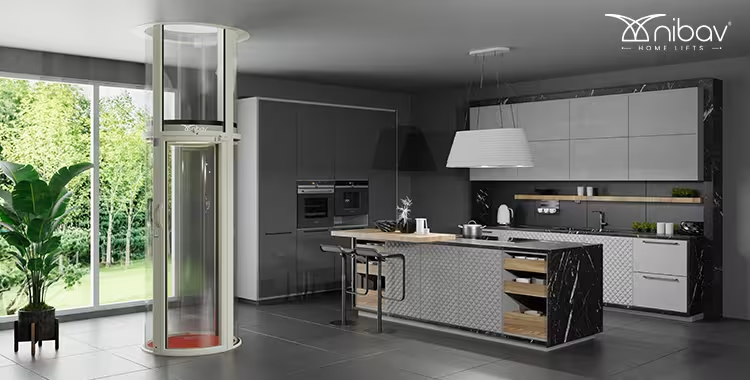
A home lift solves the whole problem instead of one slice of it. It carries a person standing or seated, with a carer alongside. It takes a wheelchair with an attendant in the larger cabin sizes. It serves every floor, not one flight. It leaves the staircase untouched. And a well-designed panoramic cabin reads as architecture rather than an aid, which matters more than people admit. Older parents frequently refuse mobility equipment because of how it looks and what it signals about them. A glass lift sidesteps that resistance entirely.
Air-driven lifts have a further advantage for elderly users specifically. They descend using controlled air pressure rather than electricity, so a power cut ends with the cabin arriving gently at the nearest floor and the doors releasing, not with a parent stranded between levels.
What Does a Home Elevator Cost in Malaysia?
Home elevator cost in Malaysia depends on four things: the cabin size, the number of stops, the finishes you choose, and how much preparation your site needs. Air-driven residential lifts generally run from around MYR 89,900 for a compact two-person model up to roughly MYR 179,900 for the largest wheelchair-capable cabins at four stops with premium finishes.
Two cost factors get overlooked, and both favour air-driven systems:
Civil works. A conventional hydraulic or traction lift needs a pit dug below the lowest floor, a shaft built, and often a machine room. In an occupied home that is weeks of contractors, dust and structural work, and it is frequently the largest line item on the invoice. Self-supporting air-driven lifts need none of it. You need a flat floor, a power point and some minor making-good.
Running cost. These lifts draw power only while ascending. Descent uses air pressure, so it costs nothing. With far fewer moving parts and no lubrication requirement, annual servicing is meaningfully lighter than a traditional lift. Over a fifteen-year ownership period, the gap in total cost of ownership is larger than the gap in purchase price.
Ask every supplier for an itemised quote covering the lift, delivery, installation, electrical work, making-good, commissioning, warranty terms and the annual service charge. A headline price without those lines attached is not a comparable number.
How Nibav Lifts Malaysia Designs for Aging Adults
Nibav Lifts Malaysia, operating as The Elite Elevators Sdn. Bhd., builds air-driven vacuum home lifts specifically for retrofitting into homes that are already lived in. For a household installing primarily for an elderly parent, a few design decisions matter more than the brochure gloss.
Installation runs 4 to 5 working days on a prepared site. There is no pit, no machine room and no support structure, because the shaft carries its own load. For a family caring for someone frail, that difference is not a convenience, it is the difference between a manageable week and a month of upheaval.
The safety package is built around the failure cases that frighten families most. Emergency Descent brings the cabin to the nearest floor during a power loss. Battery 2.0 keeps cabin lighting and ventilation running through an outage, with auxiliary power for up to 30 minutes. A Rapid Rescue Latch lets doors be opened manually, and Layman Rescue provides guided instructions so a family member with no technical training can manage a basic recovery. A Child Switch restricts unsupervised use by grandchildren. Overload sensors prevent operation if weight limits are exceeded, and a triple door-lock system stops any movement until every door is verified closed. GSM connectivity keeps two-way emergency communication live even when the cabin is idle. The lifts are TÜV NORD certified to European safety and performance standards.
For wheelchair users, cabin width is the specification that decides everything. The 1,240 mm cabin on the Max models gives step-free wide entry with room for a wheelchair and an attendant together, which the compact models cannot do.
Nibav Home Lift Range: Which Model Suits an Elderly Parent
| Model | Internal cabin | Capacity | Clear space needed | Best suited to | From |
| Series III Standard | 749 mm | 210 kg | 1,010 mm | One senior, walking unaided or with a cane; tight terrace footprint | MYR 89,900* |
| Series IV Standard | 830 mm | 210 kg | 1,010 mm | A senior with a carer standing alongside | MYR 119,900* |
| Series IV Max | 1,240 mm | 240 kg | 1,430 mm | Daily wheelchair use with an attendant | MYR 146,900* |
| Series V | 830 mm | 210 kg | 1,010 mm | A senior plus carer, with automatic doors and premium finishes | MYR 119,900* |
| Series V Max | 1,240 mm | 240 kg | 1,430 mm | Wheelchair access with the widest doorway and auto-opening doors | MYR 149,900* |
All models serve up to 4 stops (G+3) with a maximum travel height of 13,500 mm. * Starting rates, excluding applicable taxes, and varying with customisation.
If a wheelchair is in the picture now or likely within a decade, go to a Max cabin. Families who buy the compact size to save money and then need width three years later cannot upgrade the cabin. That is the one decision on this list that is genuinely hard to reverse.
Frequently Asked Questions
1. Is a home elevator safe for an elderly person to use alone?
Yes, when it has the right features. Look for automatic emergency descent, battery backup for lighting and ventilation, door interlocks that prevent movement unless every door is locked, overload sensors, a grab handle, non-slip flooring, and two-way emergency communication. A simple touchscreen or large-button control also matters, because a senior with poor eyesight or arthritic hands needs to operate it without help.
2. How much space do I need in a Malaysian terrace house?
A compact air-driven lift needs about 1,010 mm of clear space, roughly the footprint of a large armchair. Most installations use a stair void, a corner, or a lightwell. Because the shaft is self-supporting, it does not need a load-bearing wall behind it.
3. Can a home lift take a wheelchair?
Only if the cabin is wide enough. A 1,240 mm internal cabin with a wide, step-free entry takes a wheelchair with an attendant. Compact cabins around 749 to 830 mm suit a standing or seated passenger but not a wheelchair with a carer.
4. What happens during a power outage?
On an air-driven lift, the cabin descends to the nearest floor using controlled air pressure and the doors release so the passenger can step out. Battery backup keeps lighting and ventilation running. Confirm the auxiliary power duration in writing before purchase.
5. Will installing a lift damage my house or reduce its value?
A self-supporting air-driven lift needs no pit, machine room or structural reinforcement, so the impact on your existing structure is minimal. On resale value, home lifts are generally read as a premium feature in Malaysia’s multi-storey housing market, particularly to buyers with elderly family members.
Looking for the Perfect Home Elevator?
Discover Nibav Lifts range of premium home lifts and residential elevators. Find the right elevator for your home with expert guidance.
Speak to Our Elevator Experts
Discover Our Elevator Range