 By Nadia Khalis on November 26, 2026 at 4:50 am |


What Are Compact Air-Driven Elevators and How Do They Work?
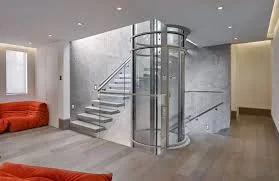
Most people see an air-driven home elevator the same way: they see a glass cylinder rising through a living room, notice there is no visible shaft, no cables, no machine room humming somewhere, and immediately want to know what is holding it up. It is a fair question. Everything we have been taught about lifts involves steel ropes, a counterweight and a pit in the ground.
The scepticism becomes a problem when it stops a good decision. Families who genuinely need a lift talk themselves out of one because they cannot picture the mechanism, or because a contractor told them any lift means digging a pit and building a shaft. So they either abandon the idea, or they get quoted for a conventional hydraulic lift with weeks of construction and a bill dominated by civil works rather than the lift itself.
The mechanism is simpler than a cable lift, not more complicated. Air-driven lifts move a cabin through a sealed tube by changing air pressure above it, using a technology principle that has been in industrial use for over a century. Understanding it in five minutes will tell you whether it suits your home. This guide explains the physics, the real dimensions, the failure behaviour and the pricing in Malaysia.
Table of Contents
- Who This Technology Suits, and Who It Doesn’t
- How a Pneumatic Home Elevator Actually Works
- What “Compact” Means in Real Numbers
- Home Elevator Price in Malaysia: What Drives the Number
- How Nibav Lifts Malaysia Engineers Its Air-Driven Range
- Nibav Air-Driven Range: The Numbers That Matter
- Frequently Asked Questions
Who This Technology Suits, and Who It Doesn’t
Air-driven lifts solve one problem extremely well: adding vertical access to a house that was never designed for it. They suit:
- Finished, occupied homes where structural construction is impractical
- Double and triple-storey terraces, semi-Ds, bungalows and duplexes
- Homes with no space for a conventional shaft
- Households of two to three passengers, or a wheelchair user with an attendant
- Renovation and retrofit projects where preserving the existing structure matters
- Owners who want the lift to look intentional rather than industrial
They are not the right tool for high-rise buildings, commercial passenger traffic, freight, or homes needing more than four stops. Capacity tops out around 240 kg and travel height around 13,500 mm. If you need to move a piano or serve six floors, this is not your technology, and a supplier who claims otherwise is overselling.
How a Pneumatic Home Elevator Actually Works
The whole system has three parts: a sealed transparent cylinder, a cabin that fits inside it with a seal around the top, and a set of turbines mounted at the head of the cylinder.
Going up. The turbines pull air out of the section of cylinder above the cabin, reducing pressure there. The air below the cabin remains at normal atmospheric pressure. That difference in pressure produces upward force on the cabin, and the cabin rises. Nothing pulls it. The air beneath it pushes it, because the air above has partly been removed. Atmospheric pressure at sea level is roughly 10 tonnes per square metre, so a modest pressure differential across a cabin roof generates ample lifting force.
Going down. The turbines stop. A valve releases air back into the upper chamber in a controlled way, the pressure difference equalises gradually, and the cabin descends under its own weight at a regulated rate. This is the part that surprises people: descent consumes no electricity at all. Gravity does the work and the valve simply governs the speed.
Stopping. Mechanical latches engage at each landing to hold the cabin level and locked while passengers enter and exit. The cabin is not held by air pressure while stationary.
Three consequences follow from this design, and they are the reason the technology exists:
No pit is required, because nothing needs to travel below the lowest floor. No machine room is required, because the turbines sit on top of the cylinder. And no counterweight, cable, pulley or hydraulic fluid exists in the system, which removes most of the components that wear out and need lubrication in a conventional lift.
The failure behaviour is also worth understanding, since it is the opposite of a cable lift’s. If power is lost, the turbines simply stop and the natural state of the system is controlled descent. The cabin drifts down to the nearest landing and the doors release. There is no scenario where the lift needs power to get you out.
What “Compact” Means in Real Numbers
Compact home elevator is a phrase every brand uses, so ignore it and ask for two measurements instead.
Clear space required is the total floor area you must surrender, including the cylinder wall and the running clearance. This is the number that decides whether it fits your stair void.
Internal cabin diameter is the space you actually stand in. This is the number that decides whether it is comfortable and whether a wheelchair fits.
The gap between the two tells you how efficient the design is. Some manufacturers publish this as Return of Space, the percentage of the footprint returned as a usable cabin. A 72 to 77 percent ROS is strong for a round cabin.
In practical terms, a compact air-driven lift needs roughly 1,010 to 1,430 mm of clear space, which is about the footprint of a large armchair, and gives a cabin of 749 to 830 mm. That takes one standing passenger comfortably, or two at a squeeze, or one passenger with a carer. A wheelchair-capable cabin needs around 1,430 mm of clear space to deliver a 1,240 mm cabin.
Because the shaft carries its own load, it does not need a wall behind it. Common placements in Malaysian homes are the void in the middle of a switchback staircase, an outside corner of a living area, a lightwell, or against a mezzanine edge.
Home Elevator Price in Malaysia: What Drives the Number
Home elevator price for air-driven systems in Malaysia typically starts around MYR 89,900 for a compact model and reaches roughly MYR 179,900 for the largest cabin at four stops with premium finishes. Four variables move the figure:
Cabin size. The single biggest driver. Moving from a compact to a wheelchair-capable cabin is a substantial step in both price and clear space.
Number of stops. Each additional landing adds a cylinder, a doorway assembly, landing mechanics and commissioning time.
Finishes. Colour, texture, flooring, lighting, engraving and cabin height options.
Site condition. A flat, finished floor with a nearby power point needs almost nothing. An uneven floor or a distant electrical supply adds preparation.
What is usually absent from the quote is the item that dominates a conventional lift budget: excavation, shaft construction and a machine room. That is where the cost comparison genuinely shifts, and it is also why the installation timeline is measured in days rather than weeks.
How Nibav Lifts Malaysia Engineers Its Air-Driven Range
Nibav home lifts are air-driven vacuum home lifts using reliable technology and components. The cabins and structure combine aerospace-grade aluminium, galvanised steel and reinforced polycarbonate panels, chosen for a shaft that is self-supporting and light enough not to require structural reinforcement of the house.
The units arrive as a completely knocked-down modular kit. Sections are sized to pass through standard doorways, which matters more than it sounds in a terrace house with a narrow entry. Technicians assemble on site, and a prepared site takes 4 to 5 working days from delivery to a commissioned lift. Site requirements are a flat floor, an electrical point and minor making-good.
The lifts run on a regular 3.7 kVA supply and draw power only during ascent. Fewer moving parts and no lubrication requirement mean lighter servicing than a hydraulic or traction system. All models are TÜV NORD certified, produced in an ISO-certified quality management facility.
Nibav Air-Driven Range: The Numbers That Matter
| Specification | Series III Standard | Series IV Standard | Series IV Max | Series V | Series V Max |
| Clear space required | 1,010 mm | 1,010 mm | 1,430 mm | 1,010 mm | 1,430 mm |
| Internal cabin diameter | 749 mm | 830 mm | 1,240 mm | 830 mm | 1,240 mm |
| External cylinder diameter | 935 mm | 933 mm | 1,363 mm | 933 mm | 1,363 mm |
| Capacity | 210 kg | 210 kg | 240 kg | 210 kg | 240 kg |
| Maximum stops | 4 (G+3) | 4 (G+3) | 4 (G+3) | 4 (G+3) | 4 (G+3) |
| Max travel height | 13,500 mm | 13,500 mm | 13,500 mm | 13,500 mm | 13,500 mm |
| Return of Space | — | 72% | 77% | 72% | 77% |
| From | MYR 89,900* | MYR 119,900* | MYR 146,900* | MYR 119,900* | MYR 149,900* |
* Starting rates, excluding applicable taxes, and varying with customisation.
A Grande option adds 170 mm of cabin height on selected models, worth specifying if anyone in the household is tall.
Frequently Asked Questions
1. Is an air-driven elevator safe?
The safety case rests on how it behaves when things go wrong. Descent is the system’s natural state without power, so a power cut results in a controlled arrival at the nearest floor rather than a stranded cabin. Mechanical latches hold the cabin at each landing, door interlocks prevent movement until all doors are verified locked, overload sensors block operation above the weight limit, and battery backup maintains lighting, ventilation and emergency communication. Look for TÜV NORD or equivalent European certification.
2. Does a pneumatic home elevator need a pit or a machine room?
No. Nothing travels below the lowest floor, so there is no pit, and the turbines are mounted on top of the cylinder, so there is no separate machine room. This is the core practical advantage over hydraulic and traction lifts in an existing home.
3. How much electricity does it use?
It draws power only while ascending, typically on a standard 3.7 kVA single-phase supply. Descent uses gravity and controlled air release, so it consumes no electricity. Real-world running cost is comparable to a large household appliance used a few minutes a day.
4. Can it be installed in a house that is already finished and occupied?
Yes, and that is the main use case. The kit passes through standard doorways, needs no structural work, and a prepared site is completed in 4 to 5 working days. Expect minor making-good rather than construction.
5. How noisy is it?
The turbines produce the sound, and it is present mainly during ascent. Insulated cabins and sound-damping treatment keep it in the range of a household appliance rather than machinery. Ask for a demonstration in a showroom and listen from outside the cabin as well as inside, because that is where your family will hear it.
Looking for the Perfect Home Elevator?
Discover Nibav Lifts range of premium home lifts and residential elevators. Find the right elevator for your home with expert guidance.
Speak to Our Elevator Experts
Discover Our Elevator Range