 By Nadia Khalis on November 24, 2026 at 4:20 am |


Elevator Maintenance Checklist: Your Key To Zero Breakdowns
A home elevator is built to make everyday movement easier, but like any mechanical system, it needs regular attention to remain dependable. Small warning signs—such as unusual noises, uneven stopping, or changes in ride performance—should not be ignored, as preventative maintenance can help identify potential equipment problems before they become larger issues.
That makes home elevator maintenance an important part of responsible elevator ownership. Beyond keeping the lift operating smoothly, routine inspections can help support home elevator safety and ensure that key components continue to perform as intended. Professional maintenance is particularly important because elevator servicing involves specialised equipment and safety procedures.
A clear elevator maintenance checklist can make this process easier for homeowners by highlighting the areas that need regular attention and helping them keep track of scheduled servicing. From checking doors and controls to monitoring unusual sounds and arranging professional inspections, a systematic approach can help reduce the likelihood of unexpected downtime.
In this guide, we break down the essential maintenance points every home elevator owner should know and explain how consistent servicing can contribute to safer, more reliable everyday operation.
Table of Contents
- Why An Air-Driven Home Elevator Needs Less Maintenance?
- What Are The Factors That Complete The Home Elevator Maintenance Checklist?
- Table On Monthly And Annual Checklist:
- What Are The Home Elevator Safety Checks You Should Never Skip?
- What Does Nibav Lifts Service Visit Cover?
- How Does Nibav Lifts Support Owners With Warning Signs?
- FAQs
Why An Air-Driven Home Elevator Needs Less Maintenance?
A traction lift has a counterweight, hoist ropes, a gearbox and a machine room. A hydraulic lift has oil, seals, a pump and a reservoir. Both bring a maintenance schedule built around lubrication, rope inspection, oil condition and wear on components under constant tension.
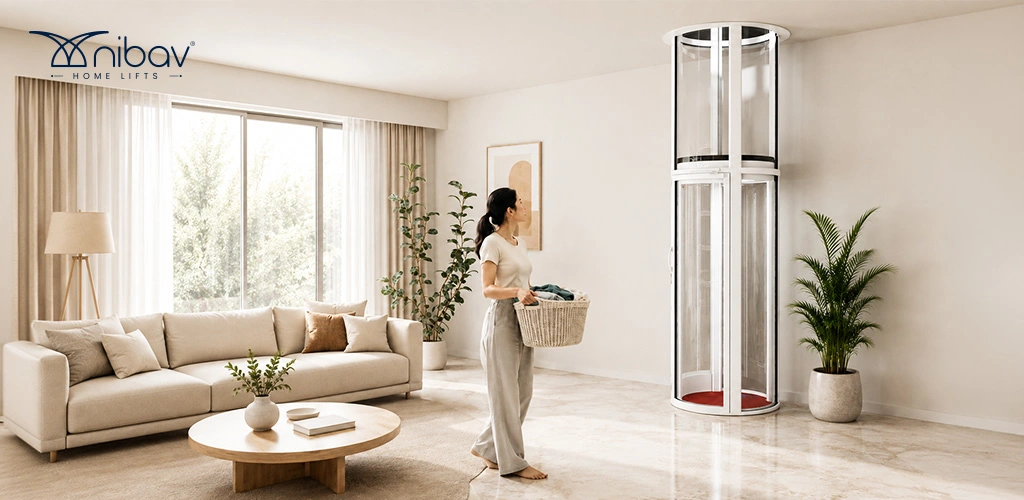
A Nibav Lifts home elevator has none of those. The cabin travels on a controlled column of air inside a self-supporting shaft of aerospace-grade aluminium and reinforced polycarbonate. There is no rope to inspect, no gearbox to service, no oil to change and, with grease-less technology, nothing requiring routine lubrication. Fewer moving parts means less wear, and annual servicing costs are generally lower than for a traditional home elevator.
What does need attention is a much narrower set of items: the vacuum seal and motor at the heart of the system, the door locks and sensors, the battery backup, and the landing accuracy. That is roughly what the checklist below covers.
What Are The Factors That Complete The Home Elevator Maintenance Checklist?
Three lists, split by who should be doing the work. Anything involving panels, brakes, seals, wiring or the shaft interior is technician work, not homeowner work.
Table On Monthly And Annual Checklist:
| Monthly Checklist | Annual Checklist |
| Full-travel ride | Vacuum seal and motor |
| Landing accuracy | Door interlocks |
| Cabin light and fan | Brake system |
| Touchscreen | Precision landing |
| Polycarbonate panels | Battery backup |
| GSM cabin phone | Overload and obstruction sensors |
| Floor and grab handle | Structure and doors |
Two notes on the owner lists. Polycarbonate is not glass: ammonia-based glass cleaners and abrasive pads can crack or scratch it permanently, so mild soap and water is the safe default, and check your manual before using anything else. And landing accuracy is the most useful early warning available to a non-technical owner. A cabin that begins stopping slightly high or low is telling you something before any other symptom appears.
What Are The Home Elevator Safety Checks You Should Never Skip?
Some items on those lists are convenient. These are the ones that matter when something has already gone wrong, and they are the reason the annual service is not optional.
Emergency descent: On loss of power, the cabin should travel to the nearest landing under control. This is the single most important function to have tested annually, because it is the one nobody discovers is faulty until a blackout.
Battery backup: It keeps lighting and ventilation running and supports the descent. Batteries degrade quietly on a predictable timescale, so capacity needs checking rather than assuming. Series V models carry Battery 2.0 with 30 minutes of auxiliary power.
Door locks and sensors: A triple-layer door lock prevents movement unless every closure is verified. Sensors and interlocks are the most safety-critical items in daily use and the most exposed to wear.
Rapid Rescue Latch (RRL): The manual release that allows doors to be opened in an emergency. Everyone in the household should know it exists and where it is before they need it.
Emergency communication: The built-in GSM phone, and on Series V the SmartConnect™ touchscreen communication with Stationary GSM that works even when the lift is idle. Test that a call actually connects, not just that the button lights up.
Overload and obstruction sensors: These prevent movement when weight limits are exceeded or the path is blocked. Standard Nibav Lifts models are rated at 210 kg (462 lbs) and Max variants at 240 kg (529 lbs).
Household knowledge is part of home elevator safety too. Anyone who uses the lift should know how to trigger the emergency landing, where the manual release is, and what number to call. A Layman Rescue procedure exists precisely so a non-technical person can act safely.
What Does Nibav Lifts Service Visit Cover?
When you book an annual service, expect the technician to work through the full technician column above and to leave you with a written record. Specifically:
The core wear items: Vacuum seal and motor condition. These are the components Series V covers under CoreShield™, a 25-year warranty on the motor and vacuum seal, which is a reasonable indicator of where the engineering expects the long-term risk to sit.
Diagnostics rather than guesswork: The error log system records faults and events, so a technician should be reading history, not just testing what happens to be visible on the day. Ask what the log showed.
Safety function tests, individually: Emergency descent, brakes, door interlocks, sensors, backup lighting and ventilation, were tested and recorded one by one.
Landing calibration: Precision Landing Levers hold the cabin level at each floor; drift here is normal over years and correctable.
A written report: Date, work performed, faults found, parts replaced, and anything flagged for next time. Without this you have no maintenance history, which matters both for warranty claims and for resale.
How Does Nibav Lifts Support Owners With Warning Signs?
Call a technician rather than waiting for the next scheduled visit if you notice any of these:
- A new sound, or a familiar sound that has changed in pitch or volume
- The cabin stopping above or below a landing, even slightly
- Doors that hesitate, need a push, or reopen without cause
- The touchscreen freezing, resetting, or displaying a fault code
- Cabin lighting or fan behaving inconsistently
- Any smell of burning, at any time, which means stop using the lift immediately
- The lift completing a descent more slowly than it used to
The last two matter most. A burning smell is a stop-immediately signal, and a change in descent behaviour can indicate the air seal, which is a core component rather than a peripheral one.
Nibav Lifts are TÜV NORD certified, engineered to comply with European safety standards, and manufactured under an ISO-certified quality management system, which sets the baseline the service regime is designed to maintain.
FAQs
1. How often does a home elevator need maintenance?
An annual technician service plus simple monthly owner checks is the practical standard. Nibav Lifts home elevators are designed for low maintenance, with no counterweight, hoist rope, gearbox or hydraulic oil and grease-less technology, so there is no routine lubrication schedule.
2. What should be on a home elevator maintenance checklist?
Monthly owner checks: listen for changed sounds, confirm level landings, test lighting, fan and the GSM phone, and clean polycarbonate panels with mild soap and water.
Annual technician tasks on a Nibav Lifts elevator: vacuum seal and motor inspection, door interlock verification, emergency descent test, brake inspection, precision landing calibration, battery backup check, sensor testing and error log review.
3. Is a home elevator safe during a power outage?
Yes. A Nibav Lifts home elevator performs an Emergency Descent to the nearest landing, holds level using Precision Landing Levers, and keeps backup lighting and ventilation running. The Rapid Rescue Latch (RRL) allows manual door release, and Series V adds Battery 2.0 with 30 minutes of auxiliary power plus Stationary GSM communication.
4. Do air-driven home elevators need less maintenance than traditional lifts?
Yes. A Nibav Lifts air-driven home elevator has no counterweight, hoist rope, gearbox or hydraulic oil, and uses grease-less technology, so the components that dominate a conventional maintenance schedule are simply absent.
5. Does a home elevator still need servicing if it is rarely used?
Yes, and the annual interval should not be extended. Two components of Nibav Lifts service visit check degrade with time rather than with use: the battery backup, which fades on a predictable timescale whether or not the lift is running, and the vacuum seal, which is the core of an air-driven system.