 By Nadia Khalis on November 20, 2026 at 4:26 am |


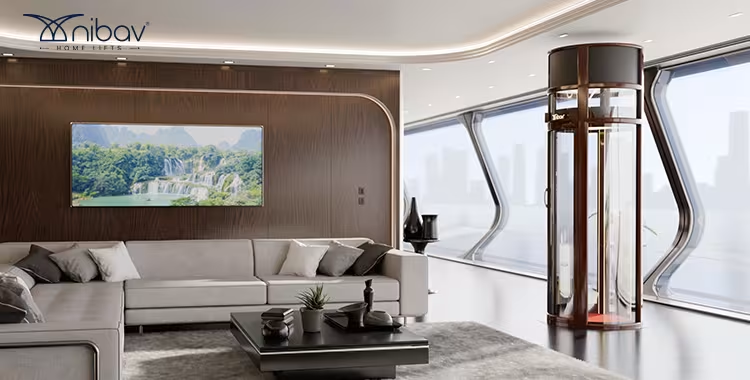
Indoor Lifts For Homes: Price Guide & Key Factors To Consider
Choosing an elevator for your home is a significant decision, but understanding the actual cost can be just as challenging as choosing the right lift. A quoted price may vary depending on the elevator technology, number of floors, cabin size, design, customisation, and installation requirements. For homeowners, this can make it difficult to compare options or determine what they are really paying for.
An indoor home lift can be a practical solution for villas, duplexes, and multi-storey houses, offering convenient floor-to-floor mobility while integrating into the home’s existing layout. For homes with limited space, a compact lift for home can be particularly appealing, provided its footprint, capacity, and installation requirements suit the property.
Understanding the home lift price is therefore about more than looking at the starting figure. Homeowners should consider the lift technology, number of stops, cabin specifications, finishes, safety features, installation complexity, and any additional work required. This guide explores the key factors that influence indoor lift costs and what to consider before choosing a lift for house use.
Table of Contents
- What Counts As An Indoor Home Lift, And Why Does It Change Your Priorities?
- What Are The Factors That Build Your Quotation And Decide The Home Lift Price?
- What Is The Pricing Of Compact Lift For Homes From Nibav Lifts?
- Which Are The Key Factors For Choosing A Lift For House?
- What A Nibav Lifts Quotation Should Include?
- FAQs
What Counts As An Indoor Home Lift, And Why Does It Change Your Priorities?
An indoor home lift sits inside the building envelope: a stair void, a corner of the living area, a lightwell. That placement changes which specifications you should weigh most heavily.
Noise: An outdoor lift can be loud without consequence. One beside a bedroom cannot. Air-driven systems have no gearbox or hoist machinery, and the Nibav Lifts range adds acoustic insulation and refined suspension for whisper-quiet travel. Ask for the decibel figure in writing before you finalise.
Finish matters: The lift is furniture as much as equipment. Series IV and V offer 24+ colour and texture options across Standard, Textured, Metallic, Hydro Matt and Hydro Glossy editions; Series III offers 14+.
Footprint: Indoor floor area is finite in a way that a side yard is not, which is why a compact lift for home use is measured on clear space and ROS rather than on cabin size alone.
Weather protection matters less: No canopy, no drainage routing, no sealing against monsoon exposure. That is one whole category of cost an indoor installation avoids.
What Are The Factors That Build Your Quotation And Decide The Home Lift Price?
Every quotation resolves into these six variables. Work through them in order, and you can price your own project approximately before anyone visits.
- Floors covered (stops)
- Model selected
- Cabin dimensions
- Design preferences
- Installation requirements
- Additional upgrades
Stops: The clearest published example is the Series V ladder: G+1 at MYR 119,900, G+2 at MYR 134,900, G+3 at MYR 149,900. Roughly MYR 15,000 per stop. Decide early whether the top floor is genuinely a landing.
Cabin dimensions: This is the largest jump and the only irreversible one. A cylinder cannot be enlarged after installation, so if a wheelchair is involved now or foreseeably, the Max step is not discretionary spending.
Model: Series IV Standard and Series V Standard share the same 830 mm cabin and the same 1,000 mm footprint. The Series V premium buys automation and warranty, not space.
What Is The Pricing Of Compact Lift For Homes From Nibav Lifts?
| Model | Starting price | Cabin | Capacity | Clear space | ROS |
| Series III Standard | MYR 89,900* | 749 mm | 210 kg | 1,010 mm | — |
| Series III Max | MYR 119,900* | 1,160 mm | 240 kg | 1,430 mm | — |
| Series IV Standard | MYR 119,900* | 830 mm | 210 kg | 1,000 mm | 72% |
| Series IV Max | MYR 146,900* | 1,240 mm | 240 kg | 1,430 mm | 77% |
| Series V Standard | MYR 119,900* | 830 mm | 210 kg | 1,000 mm | 72% |
| Series V Max | MYR 149,900* | 1,240 mm | 240 kg | 1,430 mm | 77% |
Note:
* Prices listed are starting rates, exclude applicable taxes, and may vary based on customisation.
All six serve up to 4 stops (G+3) with a maximum travel height of 13,500 mm (531 in), so travel height is not what separates them.
Two figures that change how these prices compare against conventional indoor lifts. First, there is no civil works contract, because no pit, shaft or machine room is built. On a traditional lift that omitted line is frequently the largest in the project, and it lands on your contractor’s invoice rather than the lift supplier’s. Second, running cost is minimal: a 3.7 kVA single-phase supply, drawing power only while ascending and zero power while descending, with no three-phase upgrade required.
Which Are The Key Factors For Choosing A Lift For House?
The following three factors helps to decide which kind of house lift will be efficient, if chosen. They include:
Cabin size against future users: Standard models carry 210 kg (462 lbs), around two adults. Max variants carry 240 kg (529 lbs), suit three to four people, and take a wheelchair with an attendant. Answer this on a ten-year view, not today’s.
Placement: Indoors, three positions work most often: the stair void, which is dead space already and runs the full height of the house; a corner of the living or dining area, where a transparent panoramic cabin avoids blocking sightlines; and a lightwell. Measure the actual clear circle after skirting, pipe boxing and door swing, because that is what the specification means.
Disruption: Modular, pre-engineered sections pass through standard doorways, so no crane and no façade access. Installation typically completes in 4 to 5 working days on a prepared site, subject to strata or condominium access windows. For an occupied home, a short installation window has a real if unquoted value.
One more consideration specific to indoor lifts: because the structure is self-supporting and ships Completely Knocked Down (CKD), it can be dismantled and reinstalled. Nothing is built into the building, so the lift remains an asset you own rather than a fixture you leave behind.
What A Nibav Lifts Quotation Should Include?
Ask for these in writing from any supplier you are comparing. The following are the factors to consider while choosing lifts for homes:
Certification: Nibav Lifts indoor home lifts are TÜV NORD certified, engineered to comply with European safety standards, and manufactured under an ISO-certified quality management system. Request the certificate, not the claim.
Structure specification: A self-supporting shaft of aerospace-grade aluminium and reinforced polycarbonate rated around 250 times stronger than conventional glass, requiring no pit and no machine room.
Power-failure behaviour: Emergency Descent to the nearest landing, Precision Landing Levers holding the cabin level, backup lighting and ventilation, the Rapid Rescue Latch (RRL) for manual release, a triple-layer door lock, Dual HCC emergency brakes, overload and obstruction sensors, an emergency stop button, child and parental controls, and a built-in GSM phone. Series V adds Battery 2.0 with 30-minute auxiliary power and Stationary GSM that works even when the lift is idle.
Warranty terms: Series V carries CoreShield™, a 25-year warranty on the motor and vacuum seal. Establish what is covered on whichever model you choose.
Service coverage: Nibav Lifts operates through 500+ technicians and 40+ experience centres worldwide, with an office and experience centre in Kuala Lumpur. For equipment running daily for fifteen years, response time is a specification.
A clean separation of equipment from site works insist that any competing quotation splits the two, then compare totals rather than headline figures.
FAQs
1. What is the home lift price in Malaysia? Nibav Lifts indoor home lifts start at MYR 89,900 for the Series III Standard, with the Series III Max at MYR 119,900, Series IV Standard at MYR 119,900, Series IV Max at MYR 146,900, Series V Standard at MYR 119,900 and Series V Max at MYR 149,900. Prices exclude applicable taxes and vary with stops, cabin size and finishes.
2. Does the number of floors affect home lift price? Yes. On the published Nibav Lifts Series V pricing, G+1 starts at MYR 119,900, G+2 at MYR 134,900 and G+3 at MYR 149,900, so each additional stop adds roughly MYR 15,000 for extra cylinder, an additional landing door and more installation time. Every Nibav Lifts model serves up to 4 stops (G+3).
3. Is there an extra cost for civil work on an indoor home lift? No. Nibav Lifts indoor home lifts are self-supporting and need no pit, shaft or machine room, so there is no separate civil works contract. Installation typically completes in 4 to 5 working days on a prepared site.
4. How much space does a compact lift for home use need? A Nibav Lifts Series IV Standard needs 1,000 mm of clear space for an 830 mm cabin at 72% ROS, and the Series III Standard needs 1,010 mm for a 749 mm cabin. The wheelchair-accessible Max variants need 1,430 mm for cabins of 1,160 mm or 1,240 mm at 77% ROS.
5. Is an indoor home lift quiet enough to install next to a bedroom? Air-driven systems have no gearbox or hoist machinery, and Nibav Lifts adds acoustic insulation and a refined suspension system for near-silent travel. Ask for the decibel figure in writing for the specific model and configuration you are quoted.