 By Nadia Khalis on November 27, 2026 at 3:59 am |


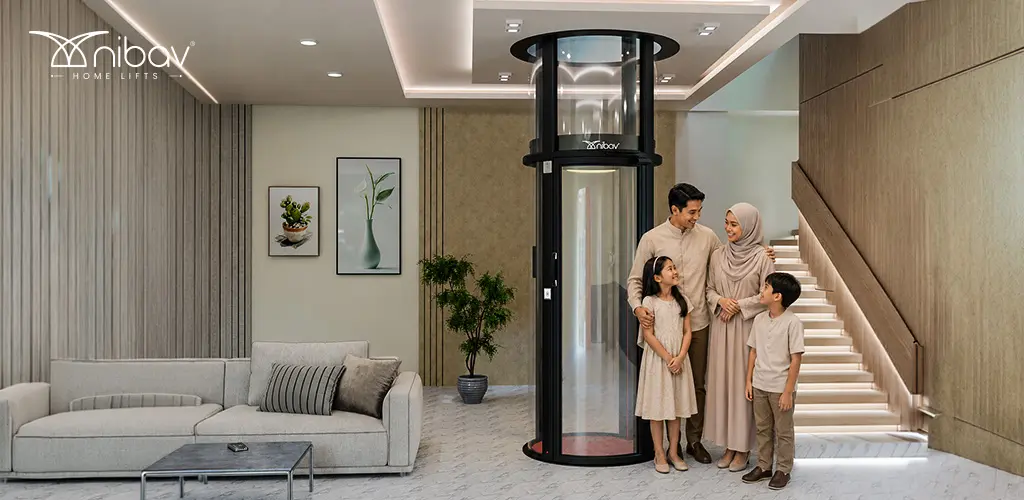
Residential Elevators With AI & IoT: What Comes Next in Smart Homes?
Your lights respond to your voice. Your aircon knows when you are on the way home. Your front door recognises your face, and your CCTV tells you which cat crossed the porch at 3am. Then you get into your smart home elevator and press a button, because the lift is the one thing in the house that still behaves like it was installed in 1985.
That gap is more irritating than it sounds, and it has real consequences. A lift with no connectivity gives you no warning before it fails. You discover a problem when someone is standing inside it, which in a household with an elderly parent or a wheelchair user is not a minor inconvenience. Servicing is scheduled by calendar rather than by condition, so you either pay for visits you did not need or miss the one you did. And nobody can tell you whether the lift has been used oddly, left open, or operated by a child unsupervised.
Connected residential lifts are closing that gap now, not in some vague future. Some of what is marketed as artificial intelligence is genuinely useful, and some is a rebranded timer. This guide separates the two, and shows you what to actually specify.
Table of Contents
Who Should Care About a Connected Lift
This matters most to:
- Households already running a connected home who want consistent control across devices
- Families with an elderly resident or wheelchair user, where downtime carries real risk
- Owners of larger homes where the lift runs many cycles a day and wear is measurable
- Anyone who travels frequently and needs remote visibility of the house
- Multi-generational households where different users need different permissions
- Architects and developers specifying smart mobility solutions for homes as part of a premium package
It matters least if the lift will be used a few times a week by two able adults in a compact home. Connectivity is not free, and a simple, robust lift is a perfectly good answer to a simple requirement.
What a Smart Residential Elevator Can Genuinely Do Today
Strip away the vocabulary and four capabilities are real and shipping.
Voice and app control. Integration with Alexa and Google Assistant lets you call the lift to a floor before you reach it, which is genuinely useful when your hands are full of shopping. App control does the same remotely. The practical benefit is small but real: no waiting at the door.
Condition monitoring and predictive maintenance. This is the substantial one. Sensors track door cycles, travel counts, seal performance, pressure behaviour and motor load, then flag drift from normal before it becomes failure. Instead of a fixed annual visit, the service team gets told which component is degrading and arrives with the right part. For a lift that a frail parent depends on daily, moving from reactive to predictive servicing is the single most valuable smart feature available.
Remote diagnostics. When something does go wrong, a connected lift lets a technician see the fault code and the event log before leaving the office. That often converts a two-visit repair into one, and sometimes resolves a configuration issue without a visit at all.
Usage intelligence and access control. Error logs, usage patterns, child-lock states and permission settings, all visible rather than guessed at. In a house with grandchildren, knowing the child switch is engaged is worth more than any convenience feature.
Two things are frequently oversold. “AI-learned routines” usually means a schedule with pattern detection, which is fine but not intelligence. And gesture control demonstrates beautifully in a showroom and gets used approximately twice in a real home. Judge a lift on the monitoring and the safety systems, not the party tricks.
The Questions to Ask Before You Buy a Connected Lift
Connectivity introduces dependencies that a mechanical lift does not have. Four questions protect you.
Does it work fully offline? The answer must be yes. If losing your internet connection degrades the lift’s core function or its safety systems, walk away. Connectivity should add monitoring and convenience on top of a lift that is completely functional without it. Emergency descent, door interlocks, brakes and emergency communication must all be independent of the network.
Is emergency communication on the network or on GSM? It should be GSM, on its own cellular link. An emergency call that routes through your home Wi-Fi fails in exactly the situation you need it, because a power cut usually takes the router with it. Look for stationary GSM that stays live even when the cabin is idle.
Who supports the firmware, and for how long? A lift is a twenty-year asset. A phone is a three-year asset. Ask, in writing, how long software updates and platform support are guaranteed, and what happens to the connected features if the vendor’s cloud service is discontinued.
Where does the data go? Usage logs from a lift reveal when your house is occupied and who moves through it. Ask what is collected, where it is stored, and who can access it.
How Nibav Lifts Malaysia Approaches Smart Features
Nibav Lifts Malaysia integrates advanced connectivity features into its air-driven home elevator range while ensuring that all essential safety systems operate independently and reliably.
Across the Series III and Series IV models, voice and app integration, including Alexa compatibility, handles the convenience layer. The Series V range moves the interface onto an integrated touchscreen, VividTouch, with selectable display themes and menus designed to be readable in daylight and at night, and operable by users with limited dexterity. That last point is easy to skip past and matters enormously for elderly passengers.
The more consequential feature is SmartConnect, which replaces the traditional emergency handset with communication built into the touchscreen, and stays functional during a power outage. It works alongside stationary GSM technology, which maintains two-way emergency communication even when the cabin is not in service. The emergency path does not depend on your home network.
An Error Log System on the Series IV range records fault events for diagnostics rather than leaving a technician to reproduce an intermittent problem. Greaseless technology on that range removes lubrication from the maintenance schedule entirely, which is a quieter kind of intelligence: fewer service interventions because there are fewer things to service.
Underneath all of it, the safety systems are mechanical and independent. Emergency Descent, Battery 2.0 with up to 30 minutes of auxiliary power, Brake 3.0, EEM Ride Check triple-sensor door verification, Cabin Door Detection, Smart Overload Alert, Child Switch, Rapid Rescue Latch and Layman Rescue all operate without any network connection. All models are TÜV NORD certified.
Nibav Smart Features by Model
| Feature | Series III Standard | Series IV Standard | Series IV Max | Series V | Series V Max |
| Voice / app control | Yes | Yes | Yes | Yes | Yes |
| Alexa integration | Yes | Yes | Yes | Via touchscreen | Via touchscreen |
| Touchscreen interface | — | Yes | Yes | VividTouch, themed | VividTouch, themed |
| SmartConnect built-in emergency comms | — | — | — | Yes | Yes |
| Stationary GSM emergency communication | GSM phone | GSM phone | GSM phone | Yes | Yes |
| Error Log System | — | Yes | Yes | Yes | Yes |
| Greaseless technology | — | Yes | Yes | Yes | Yes |
| Auxiliary power during outage | Battery backup | Battery backup | Battery backup | 30 minutes | 30 minutes |
| Motor & vacuum seal warranty | Standard | Standard | Standard | 25 years (CoreShield) | 25 years (CoreShield) |
| From | MYR 89,900* | MYR 119,900* | MYR 146,900* | MYR 119,900* | MYR 149,900* |
* Starting rates, excluding applicable taxes, and varying with customisation. Confirm the current smart-feature specification for your chosen model at time of quotation.
Frequently Asked Questions
1. Can I control a home elevator with my phone or with Alexa?
Yes. Connected residential lifts support app control and voice assistant integration, so you can call the cabin to a floor before you get there. Treat it as a convenience layer. Confirm that the lift’s core operation and all safety functions work normally with the app and the internet unavailable.
2. What is predictive maintenance on a home lift, and is it worth paying for?
Sensors monitor door cycles, pressure behaviour, seal condition and motor load, and flag components drifting outside normal parameters before they fail. It is worth paying for in two situations: when the lift is used heavily, and when someone in the household depends on it daily. For light use in a small household, a standard service contract is usually sufficient.
3. Will a smart elevator stop working if my internet goes down?
It should not, and if a supplier tells you otherwise, choose a different supplier. Movement, door interlocks, braking, emergency descent and emergency communication should all be independent of your network. Emergency calling in particular should run on its own GSM connection, since a power cut typically takes your router offline too.
4. Are AI powered home elevators available in Malaysia now?
Voice control, app control, touchscreen interfaces, error logging, remote diagnostics and condition-based servicing are all available in Malaysia today. Genuine machine learning that adapts the lift’s behaviour is at an earlier stage than the marketing suggests. Ask suppliers to demonstrate any AI claim in the showroom rather than describe it.
5. Do smart features increase maintenance costs?
Generally the opposite. Remote diagnostics reduce site visits and shorten repairs by letting the technician arrive informed and with the right part. Where costs rise is in ongoing platform or monitoring subscriptions, so ask whether connected features carry a recurring fee and what happens if you stop paying it.
Looking for the Perfect Home Elevator?
Discover Nibav Lifts range of premium home lifts and residential elevators. Find the right elevator for your home with expert guidance.
Speak to Our Elevator Experts
Discover Our Elevator Range