
 By Nadia Khalis on November 17, 2026 at 8:40 am |


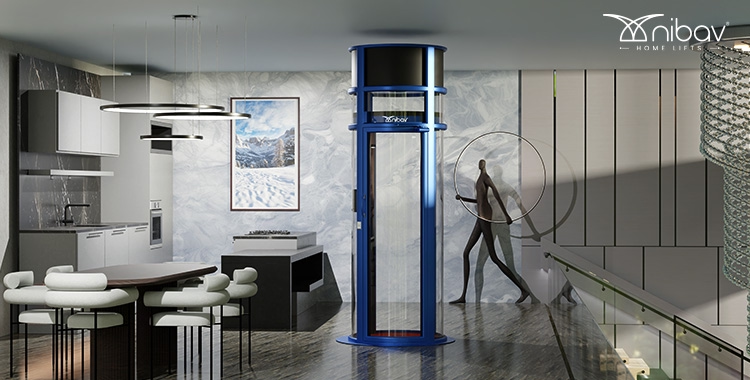
Single Floor Home Elevators: Price, Features & Benefits Explained
For many homeowners, adding a lift to a two-level house can feel like an unnecessary expense—until everyday stair use becomes inconvenient. Whether it is for ageing family members, carrying groceries between floors, or simply making the home easier to navigate, a Single floor elevator can turn a duplex into a more comfortable and accessible living space. In fact, G+1 home lifts are among the most straightforward residential elevator configurations, with options designed specifically for compact homes.
But convenience comes with an important question: how much does it cost, what features actually matter, and is the investment worthwhile? The Home elevator price can vary depending on the elevator technology, cabin size, customisation, safety features, installation requirements, and the number of floors served. A 2-floor home elevator may also have different space and structural requirements depending on the type of lift selected.
Choosing the right Home elevator company is therefore about more than comparing prices. Hopmeowners need to consider long-term reliability, safety, installation requirements, maintenance, and how naturally the elevator fits into their home’s design. This guide breaks down the cost, key features, and benefits of single-floor home elevators to help you make a more informed decision.
Table of Contents
What Does “Single Floor Elevator” Actually Mean?
Get this straight first, because it changes every number that follows.
A single floor elevator travels up one floor. It therefore serves two levels and needs two stops: the ground floor and the floor above. The industry writes this as G+1.
So a single floor elevator, a two-stop lift, a G+1 lift and a 2-floor home elevator are all the same product. The name changes depending on whether the supplier is counting floors travelled or levels served.
Why it matters commercially: Stops are one of the biggest drivers of price. If you ask for a “2-floor lift” and the supplier quotes a G+2 because they counted differently, you are paying for a stop you will never use. Confirm the configuration in writing as G+1 before comparing any two quotes.
For reference, every Nibav Lifts model supports up to 4 stops (G+3) with a maximum travel height of 13,500 mm (531 in), so a G+1 configuration sits comfortably within the range rather than at its limit.
What Is The Home Elevator Price For A Single Floor?
Here is the actual published pricing for all six models, all starting rates.
| Model | Starting price | Load capacity | Internal cabin | Clear space required | Wheelchair access |
| Series III Standard | MYR 89,900* | 210 kg (462 lbs) | 749 mm | 1,010 mm | Not supported |
| Series III Max | MYR 119,900* | 240 kg (529 lbs) | 1,160 mm | 1,430 mm | Fully supported |
| Series IV Standard | MYR 119,900* | 210 kg (462 lbs) | 830 mm | 1,000 mm | Not supported |
| Series IV Max | MYR 146,900* | 240 kg (529 lbs) | 1,240 mm | 1,430 mm | Fully supported |
| Series V Standard | MYR 119,900* | 210 kg (462 lbs) | 830 mm | 1,000 mm | Not supported |
| Series V Max | MYR 149,900* | 240 kg (529 lbs) | 1,240 mm | 1,430 mm | Fully supported |
Note:
* Prices listed are starting rates, exclude applicable taxes, and may vary based on customisation.
For a single floor elevator, the entry point is the Series III Standard at MYR 89,900, which carries two passengers in a 749 mm cabin and needs just 1,010 mm of clear space.
The clearest illustration of what stops price comes from the published Series V ladder: G+1 at MYR 119,900, G+2 at MYR 134,900, and G+3 at MYR 149,900. Each additional stop adds roughly MYR 15,000. That is the number to weigh if you are undecided about extending the lift to a third level later.
Three things sit outside these figures. Taxes are excluded from all listed prices. Finishes and accessories vary the total, with 14+ colour options on the Series III and 24+ on Series IV and V. And critically, there is no separate civil works contract, because a Nibav Lifts installation needs no pit, no shaft and no machine room. On a conventional home elevator, that omitted line is often the largest one.
Which Are The Features That Matter In A Nibav Lifts Single Floor Elevator?
When a lift travels only one floor, some specifications matter more than others and some barely matter at all. Speed, for instance, is almost irrelevant over a single storey. These are the ones that count.
Footprint for the area: The Series IV Standard returns 72% ROS (Return on Space), meaning 72% of the lift’s footprint comes back as usable cabin. The Max variants reach 77%. In a terrace house where you are fitting the lift into a stair void or a corner, that ratio decides whether it fits at all.
Self-supporting structure: The shaft is built from aerospace-grade aluminium and reinforced polycarbonate rated around 250 times stronger than conventional glass. It stands on a finished floor and needs no structural work, which is what makes retrofitting a completed home realistic.
Single-phase power: The system runs on a standard 3.7 kVA supply, drawing power only while ascending and zero power while descending, since air pressure handles the descent.
Cabin size against actual users: A 749 mm or 830 mm cabin carries two people. If a wheelchair is involved, now or foreseeably, you need the 1,160 mm or 1,240 mm cabin of a Max variant. This cannot be changed after installation, so it is the one decision to make honestly rather than optimistically.
Panoramic cabin: A 360-degree polycarbonate cabin removes the boxed-in feeling, which matters more than people expect for elderly passengers and anyone prone to claustrophobia.
Installation window: Modular, pre-engineered sections pass through standard doorways, and installation typically completes in 4 to 5 working days on a prepared site, subject to strata or condo access rules.
On the Series V, the feature set extends further: AutoGlide™ sensor-based automatic doors, GlideWide™ widest-in-class cabin doors, the VividTouch™ touchscreen with integrated SmartConnect™ emergency communication, HeartLine™ cabin engraving, and CoreShield™, a 25-year warranty on the motor and vacuum seal.
What Are The Benefits Of A 2-Floor Home Elevator From Nibav Lifts?
Over one flight of stairs, the case is more practical than luxurious.
- It removes the single highest fall risk in the house: Stairs are where domestic falls happen, and an enclosed cabin eliminates that exposure entirely for the person who needs it.
- It restores the upper floor: In many two-storey Malaysian homes, an elderly parent effectively surrenders the first floor and lives downstairs. A lift gives the whole house back.
- It costs little to run: Power on ascent only, nothing on descent, on a domestic single-phase supply.
- It needs almost no servicing: With no counterweight, hoist rope, gearbox or hydraulic oil, there are far fewer wearing parts than a traction or hydraulic lift.
- It is relocatable: Units ship in a Completely Knocked Down (CKD) format and can be dismantled and reinstalled, so the lift is an asset you own rather than a fixture left behind.
- It adds resale appeal: In premium and multi-generational housing, accessibility is increasingly a selling point rather than a curiosity.
How To Choose A Home Elevator Company In Malaysia?
Once you have settled on a G+1 configuration and a cabin size, the remaining decision is who installs and services it. Four things are worth verifying in writing.
Certification: Nibav Lifts home elevators are TÜV NORD certified, meeting international safety and performance benchmarks, and are engineered to comply with European safety standards. The production facility operates under an ISO-certified quality management system. Ask any supplier for the certificate, not the claim.
Power-failure behaviour: This is the specification families care about most and brochures cover least. A Nibav Lifts lift performs a controlled Emergency Descent to the nearest landing, holds level with Precision Landing Levers, and keeps backup lighting and ventilation running. The Rapid Rescue Latch (RRL) allows manual release, a triple-layer door lock prevents movement unless all closures are verified, and Dual HCC emergency brakes provide redundant stopping. Series V adds Battery 2.0 with 30-minute auxiliary power and Stationary GSM communication that works even when the lift is idle.
Everyday safety: Child and parental control switches, overload and obstruction sensors, an emergency stop button, Sure Stop technology, anti-slip flooring and a grab handle.
Local service reach: Nibav Lifts operates through 500+ technicians and 40+ experience centres worldwide, with a Malaysia office and experience centre in Kuala Lumpur. For equipment running daily for fifteen years, response time is a specification, not a courtesy.
FAQs
1. What is a single floor elevator?
A single floor elevator travels up one floor and therefore serves two levels, using two stops. It is also called a G+1 lift or a 2-floor home elevator. Nibav Lifts support up to 4 stops (G+3) with a maximum travel height of 13,500 mm, so a G+1 configuration sits well within the range.
2. How much does a single floor home elevator price in Malaysia?
Nibav Lifts home elevators start at MYR 89,900 for the Series III Standard. The Series III Max starts at MYR 119,900, Series IV Standard at MYR 119,900, Series IV Max at MYR 146,900, Series V Standard at MYR 119,900 and Series V Max at MYR 149,900. Prices exclude applicable taxes and vary with stops, cabin size and finishes.
3. Does a 2-floor home elevator price less than a three- or four-floor lift?
Yes. Using the published Nibav Lifts Series V pricing, G+1 starts at MYR 119,900, G+2 at MYR 134,900 and G+3 at MYR 149,900, so each additional stop adds roughly MYR 15,000 because it requires more cylinder, an extra landing door and additional installation time.
4. How much space does a single floor elevator need?
A Nibav Lifts Series IV Standard needs 1,000 mm of clear space for an 830 mm cabin at 72% ROS, and the Series III Standard needs 1,010 mm for a 749 mm cabin. The wheelchair-accessible max variants need 1,430 mm for cabins of 1,160 mm or 1,240 mm at 77% ROS. No pit, shaft or machine room is required.
5. Can a home elevator be installed in an existing house?
Yes. Nibav Lifts home elevators are self-supporting and need no pit or machine room, so they fit into stair voids, corners and lightwells in finished homes. Installation typically completes in 4 to 5 working days on a prepared site.

Nur Izzati Abdullah
This article provides a clear understanding of single-floor home elevator options and their pricing factors. I found the information about installation requirements and space planning particularly useful for homeowners considering a lift.
Daniel Wong
A very informative read! I was interested in understanding whether installing a home elevator for a single-floor property is practical. This article explains the important considerations and helps readers explore suitable options.
Muhammad Syafiq
Great article with useful insights into home elevator pricing. Understanding the different features, installation requirements and available options makes it easier to plan a home improvement project. Thanks for sharing!
Tan Mei Ling
I appreciate how this blog explains the factors that influence single-floor home elevator costs. The details about space requirements and modern lift solutions are helpful for anyone planning to improve accessibility at home.
Kavitha Raj
This is a helpful guide for homeowners exploring compact elevator solutions. I especially liked the practical information about installation and choosing a suitable lift based on household requirements. Great content!