
 By Nadia Khalis on August 18, 2026 at 5:24 am |



How to Install a Home Lift Without Renovating Your Home
You want a home lift, but the thought of what installation actually involves stops you before you even get a quote. Digging a pit into your ground floor, building a separate machine room, tearing out walls to fit a shaft, weeks of dust and noise disrupting daily life. For anyone living in an established home rather than building from scratch, that picture alone is enough to shelve the idea entirely.
That fear is completely reasonable, because it’s accurate for traditional hydraulic elevators. They genuinely do require exactly that level of civil work, which makes them impractical for most existing Malaysian homes without a renovation budget and timeline most families simply don’t have. Many homeowners give up on the idea of a home lift altogether, assuming it’s either that disruptive or not an option for their property at all.
The reality is that a pitless, shaftless home lift solves this exact problem. Built on self-supporting, air-driven technology, it needs no pit, no machine room, and no structural alterations to your existing walls, which means you can add genuine vertical access to your home without the renovation you’ve been dreading. Here’s exactly how it works.
Table of Contents
- What Makes a Pitless Home Lift Possible
- Shaftless Home Lift Technology: How It Actually Works
- Home Lift Cost for a No-Renovation Installation
- What Installation Actually Looks Like Without Renovation
- Is a Pitless Home Lift Right for Your Home?
- Why Nibav Makes No-Renovation Installation Genuinely Possible
- What Sets Nibav’s Pitless, Shaftless Lifts Apart
- Frequently Asked Questions
What Makes a Pitless Home Lift Possible
A pitless home lift eliminates the single biggest source of disruption in traditional elevator installation: the excavation. Rather than relying on a pit dug below floor level to house counterweights or hydraulic components, a pneumatic lift uses air pressure within a sealed cylinder to move the cabin, with no need for anything below the existing floor surface.
This isn’t a compromise on safety or performance. Pitless lifts built on this technology are commonly TÜV NORD certified and include the same safety systems as traditional elevators, including automatic emergency descent and precision floor levelling, without requiring any excavation to achieve them.
For homeowners who’ve already renovated once and have no appetite for a second round of construction, this distinction is often the deciding factor. A pitless design means the structural work you’ve already invested in stays untouched, rather than being partially undone to accommodate the lift.
Shaftless Home Lift Technology: How It Actually Works
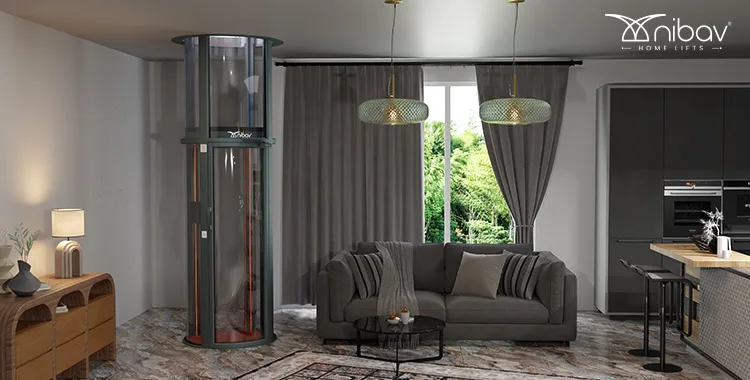
A shaftless home lift takes the same principle further. Rather than requiring a purpose-built shaft constructed into your home’s structure, the entire lift mechanism is self-supporting, housed within its own reinforced cylindrical casing that stands independently on your existing floor. It doesn’t rely on surrounding walls for structural support, which means it can be positioned in a stair void, a corner, or even against an exterior-facing wall, wherever makes the most practical sense for your home.
This self-supporting design is what makes retrofitting genuinely realistic. There’s no need to open up walls, reinforce floors, or restructure your home’s layout to accommodate it.
Home Lift Cost for a No-Renovation Installation
Home lift cost for a pitless, shaftless installation is typically lower than a traditional elevator once you account for the full project, not just the equipment itself. Traditional systems require excavation, waterproofing, structural reinforcement, and a dedicated machine room, all of which add substantial cost on top of the lift itself. A self-supporting model largely limits costs to the unit, a straightforward installation, and finishing touches around the shaft.
When comparing quotes, ask specifically what’s included. A lower quoted home lift cost that excludes site preparation, delivery, and warranty coverage isn’t necessarily the better deal once those extras are added back in. Get a full, itemised quote so you’re comparing genuinely equivalent offers.
It’s also worth factoring in the cost of not renovating. A traditional elevator installation often requires temporarily relocating your family, covering for weeks of construction disruption, and repairing finishes damaged during the process. None of those hidden costs apply to a pitless, shaftless installation, which makes the total home lift cost comparison even more favourable once the full picture is considered.
What Installation Actually Looks Like Without Renovation
Most installations for a pitless, shaftless home lift require only a flat, level floor and a single-phase power connection, both of which most Malaysian homes already have in a suitable location. There’s no excavation, no structural demolition, and no need to vacate the property for weeks at a time.
Once the site is confirmed, pre-engineered, largely pre-assembled components are delivered and installed, with most projects completed within four to five working days. Homeowners are often surprised at how little disruption the process actually causes compared to what they’d braced themselves for based on traditional elevator installations.
Dust and mess are also minimal compared to a renovation project. Because there’s no demolition or excavation involved, most installations can be completed while the household continues living normally, without needing to relocate furniture out of entire rooms or seal off large sections of the home during the process.
Is a Pitless Home Lift Right for Your Home?
If your primary concern about a home lift has been the disruption of installation rather than the concept itself, a pitless, shaftless model likely solves the exact problem holding you back. It’s particularly well suited to terrace houses, semi-detached homes, and older bungalows where structural changes are difficult, expensive, or simply undesirable in a home you’ve already finished renovating once.
Arrange a site assessment before ruling anything out. A qualified installer can confirm your available space and give you an accurate home lift cost specific to your property, rather than relying on general assumptions based on traditional elevator installations.
Why Nibav Makes No-Renovation Installation Genuinely Possible
Nibav’s entire lift range was engineered around the self-supporting, pitless, shaftless principle, not adapted from traditional elevator designs after the fact. Every model is TÜV NORD certified, meaning the no-renovation installation doesn’t come at the expense of recognised safety standards that homeowners rightly expect from any lift installed in their home.
With a physical experience centre in Kuala Lumpur, Nibav lets homeowners see exactly how compact and self-contained the system is before committing, rather than taking the no renovation needed claim on faith.
What Sets Nibav’s Pitless, Shaftless Lifts Apart
Nibav’s installation process typically takes just four to five working days from a prepared site, backed by a modular, pre-engineered build that passes through standard doorways for straightforward lift-in. Safety systems including automatic emergency descent, triple-layer door lock safety, and precision landing levers come standard across the range, not as optional extras. With technicians based locally in Malaysia, any post-installation servicing is handled quickly, without the long waits associated with importing parts or support from overseas.
Frequently Asked Questions
Can a home lift really be installed without any renovation?
Yes. Pitless, shaftless home lifts use self-supporting, air-driven technology that requires no pit, no machine room, and no structural alterations to existing walls or floors.
Is a pitless home lift as safe as a traditional elevator?
Yes, provided it’s independently certified. Reputable pitless models include the same core safety systems as traditional elevators, such as automatic emergency descent and precision floor levelling.
How much does a shaftless home lift cost compared to a traditional elevator?
A shaftless home lift is generally more affordable overall once full project costs are compared, since it avoids the excavation, waterproofing, and machine room construction traditional elevators require.
How long does installation take for a home lift without renovation?
Most pitless, shaftless installations are completed within four to five working days once the site is prepared, compared to weeks or months for a traditional elevator.
What kind of homes are best suited to a no-renovation home lift?
Terrace houses, semi-detached homes, and older bungalows where major structural changes are difficult or undesirable are typically the best fit for a pitless, shaftless installation.

Nurul Iman
Excellent guide for homeowners who want better accessibility without going through extensive structural changes.
Kelly Wong
Very informative and practical article. It clearly explains why a pitless, shaftless lift can be considered for an existing Malaysian home.
Tan Jia Hui
The safety information was reassuring, especially the mention of automatic emergency descent and floor levelling.
Liyana Zulkifli
Very informative read. The points about minimal dust, noise and disruption are important for families living in the house during installation.
Yusuf Kareem
A well-written guide with practical information. The explanation of how the lift can stand independently without relying on existing walls was interesting.
Muhammad Faris
I like that the article discusses the hidden costs and disruption associated with traditional lift installation. Good points to consider before getting a quotation.