 By Nadia Khalis on May 19, 2026 at 9:28 am |



Can a Residential Elevator Fit in Your Existing House? Expert Guide
Most homeowners in Malaysia assume one thing: installing a residential elevator means breaking walls, losing space, and spending a fortune.
That assumption is outdated.
In 2026, a retrofit home elevator can be installed into your existing house—without major reconstruction, without sacrificing your layout, and without the complications of traditional lifts.
Across Kuala Lumpur, Selangor, and Johor Bahru, more homeowners are choosing compact residential elevators to solve everyday challenges—aging family members, limited mobility, and the need for long-term convenience.
And leading this transformation is Nibav Lifts Malaysia, with advanced air-driven technology designed specifically for existing homes.
Let’s answer the question directly—and then go deeper.
Table of Contents
- Can a Residential Elevator Fit in an Existing House?
- Why Most Homeowners Think It’s Not Possible
- The Shift: Smart Retrofit Home Elevators
- How Much Space Does a Small Home Elevator Need? (Featured Snippet)
- Where Can You Install a Compact Residential Elevator?
- What Affects Residential Elevator Cost in Malaysia?
- 5 Key Factors That Influence Residential Elevator Cost
- Why Air-Driven Technology Makes Retrofitting Possible
- Best Home Elevator Models for Existing Houses
- Comparison of Elevator Models for Existing Homes
- Which Elevator is Best for Small Homes?
- Common Concerns (And the Truth Behind Them)
- Beyond Installation: The Lifestyle Shift
- Why Homeowners Choose Nibav Malaysia
- Ready to See If Your Home Qualifies?
- Frequently Asked Questions
Can a Residential Elevator Fit in an Existing House?
Yes, a retrofit home elevator can fit in most existing houses in Malaysia. Modern air-driven systems are designed to require minimal space, no deep pit, and no machine room, allowing seamless installation in compact areas without major structural changes.
Why Most Homeowners Think It’s Not Possible
Walk into any typical landed home in Malaysia—a terrace house in Selangor or a duplex in Penang—and you’ll notice the same thing: stairs dominate vertical movement.
For years, elevators were considered only for large buildings or luxury properties because traditional systems required:
- Deep pits below ground
- Machine rooms
- Heavy structural modifications
This created a strong belief:
“If my house wasn’t built for it, I can’t install one.”
But here’s where the real problem begins.
What feels manageable today—climbing stairs, carrying groceries, helping elderly parents—gradually becomes a daily inconvenience, and eventually, a safety concern.
Ignoring this doesn’t delay the problem. It amplifies it.
The Shift: Smart Retrofit Home Elevators
Today’s compact residential elevators are built differently.
Instead of forcing your home to adapt, they are engineered to adapt to your home.
Nibav Lifts Malaysia uses air-driven (pneumatic) technology, which eliminates the need for heavy mechanical systems.
This changes everything:
- No deep excavation work
- No dedicated machine room
- Minimal structural alteration
- Faster installation timelines
What once took months can now be completed in a fraction of the time—with far less disruption.
How Much Space Does a Small Home Elevator Need? (Featured Snippet)
A small home elevator typically requires a compact footprint and can be installed in areas like stair voids, corners, or unused vertical spaces. Air-driven elevators are self-supporting, making them ideal for homes with limited space in Malaysia.
Where Can You Install a Compact Residential Elevator?
This is where most homeowners are surprised.
In homes across Kuala Lumpur and Johor, installations are commonly done in spaces that were never originally intended for elevators.
A vertical void beside a staircase can often accommodate a lift. Corners of living areas, unused spaces near walls, or even external placements with floor access points can work effectively.
For terrace and semi-detached homes, the flexibility of compact residential elevators makes them particularly suitable.
The reality is simple:
Your home likely already has the space—you just haven’t identified it yet.
What Affects Residential Elevator Cost in Malaysia?
The residential elevator cost in Malaysia depends on the model, number of floors, and customisation. Retrofit-friendly elevators reduce costs significantly by eliminating heavy construction, lowering installation time, and minimising long-term maintenance.
5 Key Factors That Influence Residential Elevator Cost
Understanding cost goes beyond just the price tag. Several factors influence your investment:
First, the number of floors your elevator needs to serve directly impacts system requirements. A two-floor installation differs significantly from a four-floor setup.
Second, the home elevator model you choose determines capacity, design, and features. Compact models are generally more cost-efficient.
Third, customisation—such as cabin finishes, design elements, and additional features—can affect pricing.
Fourth, installation complexity plays a role. Homes that allow easier integration reduce labor and setup costs.
Finally, long-term maintenance is often overlooked. Air-driven systems, like those from Nibav, are designed to reduce ongoing expenses compared to traditional elevators.
Why Air-Driven Technology Makes Retrofitting Possible
Traditional elevators rely on cables, counterweights, and large mechanical systems. These require structural adjustments that most homes cannot support.
Air-driven elevators operate differently. They use pneumatic pressure to move the cabin smoothly between floors, eliminating heavy components.
With Nibav Lifts Malaysia, this means:
- Self-supporting structure
- Lower energy consumption
- Smooth and quiet operation
- Fewer moving parts, reducing wear and tear
For homeowners searching for a retrofit home elevator, this is the key innovation that makes installation practical.
Best Home Elevator Models for Existing Houses
Choosing the right model is where your decision becomes real. Not every elevator fits every home—but Nibav offers solutions tailored for different needs.
Series III – Practical and Reliable
The Series III focuses on simplicity and efficiency.
It offers smooth vertical mobility with minimal installation complexity, making it ideal for homeowners who want a straightforward retrofit home elevator without extensive customisation.
For first-time buyers, this model provides a reliable entry point into residential elevators.
Series IV – The Ideal Compact Solution
Designed specifically for tight spaces, the Series IV is one of the most efficient options for retrofit installations.
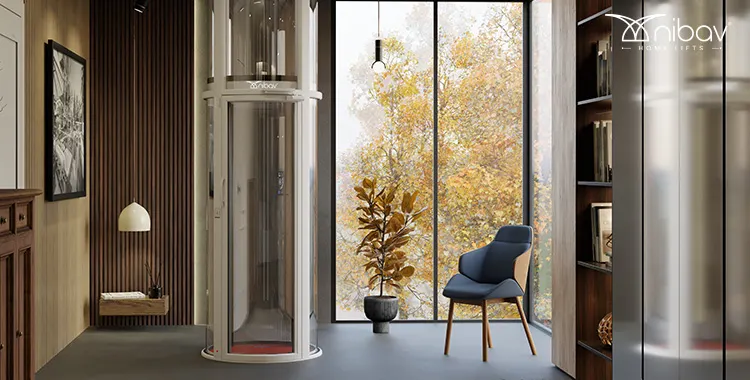
It features a compact cylindrical structure, supports multiple floors, and operates without requiring a pit or machine room. The footprint is optimised for homes where space is limited, making it a preferred small home elevator in Malaysia.
This model is particularly suitable for terrace homes and properties where every square foot matters.
Series V – Performance Meets Design
For homeowners with slightly more flexibility, the Series V delivers enhanced performance and a more refined experience.
It supports multiple stops and offers a more spacious cabin while maintaining a relatively compact design.
This model is perfect for families planning long-term use and looking for a compact residential elevator that combines performance with aesthetics.
Comparison of Elevator Models for Existing Homes
| Model | Best For | Floors Supported | Space Requirement | Installation Time | Technology Type | Key Advantage |
| Series IV | Tight spaces | 2–4 floors | Minimal | Fast | Air-driven | Highly compact design |
| Series III | Practical usage | Basic | Compact | Fast | Air-driven | Easy installation |
| Series V | Long-term performance | Multiple | Moderate | Moderate | Air-driven | Enhanced comfort and design |
Which Elevator is Best for Small Homes?
The best small home elevator for existing houses is the Series IV, as it is designed for compact spaces, requires minimal structural changes, and fits seamlessly into tight residential layouts.
Common Concerns (And the Truth Behind Them)
Many homeowners hesitate because of unanswered concerns. Let’s address them directly.
Will it damage my house?
No. Retrofit elevators are designed to integrate without major structural impact.
What happens during a power failure?
Air-driven systems are built with safety mechanisms to ensure controlled operation.
Will electricity bills increase significantly?
These elevators consume minimal power, similar to household appliances.
Is maintenance complicated?
With fewer mechanical components, maintenance is simpler and more cost-effective.
Addressing these concerns is crucial—because most decisions are delayed not by cost, but by uncertainty.
Beyond Installation: The Lifestyle Shift
Installing a residential elevator changes more than just movement—it changes daily living.
For elderly family members, it restores independence. For homeowners, it eliminates daily strain. For families, it adds safety and convenience that becomes essential over time.
There’s also a strong property advantage. Homes equipped with elevators stand out in competitive markets like Kuala Lumpur and Penang, offering higher perceived value.
A compact residential elevator is not just a feature—it’s a long-term upgrade to your lifestyle.
Why Homeowners Choose Nibav Malaysia
Nibav Lifts Malaysia has become a trusted name globally for residential elevators, with installations across multiple countries.
Their systems are built with:
- International safety standards
- Advanced air-driven technology
- Minimal construction requirements
- Efficient and reliable performance
This combination makes them a leading choice for homeowners exploring retrofit home elevator solutions in Malaysia.
Ready to See If Your Home Qualifies?
If you’ve been assuming your home can’t accommodate an elevator, you could be overlooking a solution that’s already within reach.
With Nibav Lifts Malaysia, installing a retrofit home elevator is no longer complicated—it’s practical, efficient, and designed for real homes.
Every day you delay is another day of inconvenience, risk, and missed comfort.
Book your free home assessment today and find out exactly how a compact residential elevator can fit into your space—without compromise.
Frequently Asked Questions
Can I install a retrofit home elevator without renovation?
Yes, most modern systems are designed to minimise renovation work. They can be installed with minimal structural changes, making them suitable for existing homes.
What is the average residential elevator cost in Malaysia?
The starting price is MYR 89,900* for the Series III model from Nibav Lifts Malaysia, designed for G+1 homes with a standard configuration.
How much space is needed for a compact residential elevator?
Compact elevators require minimal space and can fit into unused areas such as corners or stair voids, making them ideal for smaller homes.
Are small home elevators safe?
Yes, they are designed with advanced safety features and comply with international standards, ensuring safe and reliable operation.