 By Nadia Khalis on June 30, 2026 at 6:34 am |



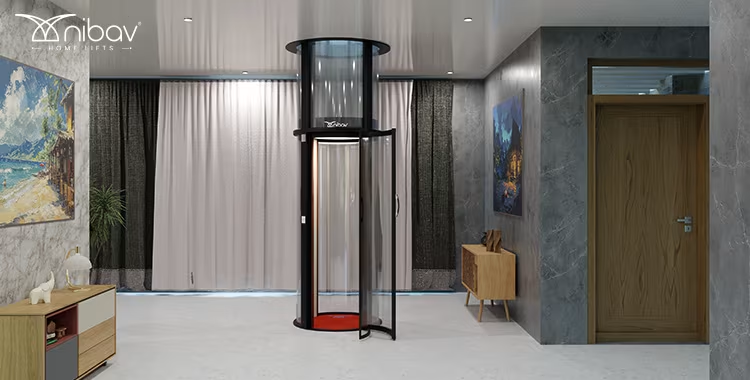
What Is a Pneumatic Home Lift? Features, Benefits & Costs
Most homeowners researching home lifts quickly encounter a technology they have not come across before: the pneumatic, or air-driven, home lift. It sounds futuristic. It looks like something from a design magazine. And when you read that it requires no pit, no machine room, and installs in under a week, the natural reaction is scepticism. Surely something this convenient comes with a catch?
The challenge is that most of the information available online either oversimplifies how pneumatic lifts work or buries the practical details under marketing language. Homeowners who want to understand the technology before committing to a purchase are left piecing together an incomplete picture — and often talking themselves out of a decision that would genuinely improve their daily life.
This guide resolves that. It explains exactly how a pneumatic home lift works, what features matter, what benefits are genuine versus overstated, and what the real home lift cost looks like in Malaysia. By the end, you will have the clarity to make an informed decision with confidence.
Table of Contents
How Does a Vacuum Home Lift Actually Work?
A pneumatic home lift — also called a vacuum lift or air-driven home lift — operates on the principle of air pressure differentials. Here is the complete mechanism explained clearly:
Ascending
A turbine at the top of the transparent cylindrical shaft creates a low-pressure zone (partial vacuum) above the cabin. The atmospheric air pressure below — which is higher — pushes the cabin upward smoothly. The turbine runs on electricity, drawing approximately 3.7 kVA of power during ascent.
Descending
A precision control valve at the top of the cylinder gradually allows air to flow back in, restoring pressure above the cabin. Gravity then lowers the cabin at a controlled rate — consuming zero electricity on the way down. This makes the pneumatic lift one of the most energy-efficient vertical transport systems available for residential use.
Structure
The cylindrical shaft is self-supporting — it stands independently on the existing floor without structural integration with walls or beams. The entire mechanical system is contained within the unit. No external machine room is needed, no hydraulic reservoir, and no pit below the ground floor. The only structural change required is a circular floor opening at each level the lift serves.
Key Features of an Air-Driven Home Lift
When evaluating a pneumatic lift for home use in Malaysia, these are the features that separate a well-engineered product from a basic alternative:
- 360-degree panoramic glass cabin: Reinforced polycarbonate — 250 times stronger than conventional glass — provides an open, luminous cabin experience that eliminates any sense of enclosure.
- Self-supporting cylinder: No walls, beams, or external structural support required. The shaft stands independently on any standard finished floor.
- Auto-opening doors (premium models): Intelligent sensors detect approach and open doors smoothly — a significant comfort upgrade for elderly users and wheelchair passengers.
- VividTouch smart display: Responsive touchscreen controls with customisable themes replace traditional floor buttons with an intuitive interface.
- SmartConnect emergency communication: Built into the touchscreen display, this system allows emergency communication even during power outages — critical for elderly and solo users.
- 25-year CoreShield warranty (Series V): The motor and vacuum seal are warranted for 25 years — reflecting manufacturer confidence in long-term engineering quality.
- 24+ colour and finish options: From Standard editions to Textured, Metallic, and Hydro finishes — the lift can be designed to match virtually any Malaysian interior.
Genuine Benefits of a Pneumatic Lift for Home Use
The benefits of air-driven home lifts are frequently listed in promotional material. Here is an honest evaluation of which ones are genuinely significant in a Malaysian residential context:
- No civil construction — this is transformative for existing homes. Eliminating the pit, shaft, and machine room removes MYR 50,000 to MYR 100,000 from the total cost and weeks from the project timeline. For most homeowners, this single benefit makes air-driven technology the only practical choice.
- Installation in 4 to 5 working days — not weeks or months. The home stays functional throughout the installation process. Family members are minimally disrupted.
- Low energy consumption — the lift draws power only during ascent. Descent is free. Operating costs are comparable to a standard household appliance, significantly below hydraulic alternatives.
- Minimal maintenance — no hydraulic fluid to change, no cables to inspect, no lubrication schedule. Approximately 90% lower annual maintenance cost than hydraulic equivalents.
- Eco-friendly operation — no fluid risk, no chemical disposal, and low electrical consumption make pneumatic lifts the most environmentally responsible residential elevator option available.
- Design elegance — the transparent glass cylinder adds visual interest and natural light to the surrounding area. Many homeowners find the lift enhances their home’s interior rather than simply occupying space within it.
Home Lift Cost: What Does a Pneumatic Lift Actually Cost in Malaysia?
The home lift cost question deserves transparency. Here is an accurate picture of what Malaysian homeowners pay for air-driven pneumatic lifts in 2026:
- Series III Standard (entry level): From MYR 69,900* — includes installation, safety features, 14+ colour options, and TÜV NORD certification.
- Series IV Standard (mid-range with smart features): From MYR 109,900* — adds AI and voice control readiness, frameless doors, advanced suspension.
- Series IV Max (wider cabin, wheelchair access): From MYR 136,900* — 1,240 mm cabin, 240 kg capacity.
- Series V Standard (premium with 25-year warranty): From MYR 119,900* (G+1) — auto-opening doors, HeartLine engraving, SkyMark ceiling, VividTouch display.
- Series V Max (luxury wheelchair-accessible): From MYR 149,900* (G+3) — widest cabin in class, all Series V premium features.
All prices include full installation with zero civil construction costs. Annual running costs are low — energy comparable to a household appliance, maintenance required once every four months, no fluid or lubrication needed.
Is a Pneumatic Home Lift Right for Your Malaysian Home?
A pneumatic home lift is the right choice for an existing Malaysian home if you need vertical mobility between 2 to 4 floors, have approximately 1010 mm of clear floor space available, and want installation completed without major renovation. It is the most practical solution for terrace houses, semi-Ds, townhouses, bungalows, and villas where traditional shaft-based elevators are not feasible.
If your requirements include more than 4 stops, very high weight capacity above 240 kg, or custom cabin dimensions beyond the available cylinder sizes, other elevator types may be worth evaluating. For the vast majority of Malaysian residential buyers, however, the pneumatic vacuum lift offers the best combination of practicality, design, safety, and value available in the current market.
The pneumatic home lift is not a niche product for early adopters. It is a mature, certified, widely adopted technology that has been installed in thousands of Malaysian, Singaporean, and Indian homes. The combination of engineering simplicity, installation speed, low maintenance, and genuine design quality makes it the most compelling residential elevator option available in 2026 for the vast majority of homeowners considering their first lift purchase.
Frequently Asked Questions
Q1: What is the difference between a pneumatic lift and a vacuum lift?
They are the same technology referred to by different names. Pneumatic lift, vacuum lift, and air-driven home lift all describe an elevator that uses air pressure differentials to move the cabin — ascending via vacuum, descending via gravity and controlled air release.
Q2: How much electricity does a pneumatic home lift use?
A pneumatic home lift draws approximately 3.7 kVA during ascent. Descent consumes zero electricity. Total monthly electricity cost depends on usage frequency — for typical family use, the cost is comparable to running a standard home appliance.
Q3: How safe is a vacuum lift during a power outage?
Very safe. During a power cut, the emergency descent system automatically lowers the cabin to the nearest floor using gravity and controlled air release — no battery required. The Battery 2.0 backup maintains cabin lighting and ventilation for up to 30 minutes simultaneously.
Q4: Can a pneumatic home lift be installed in any existing Malaysian home?
In the vast majority of cases, yes. A site feasibility assessment confirms suitability. The self-supporting design works in terrace homes, semi-Ds, bungalows, townhouses, and villas — both new builds and existing properties throughout Malaysia.
Q5: How long does a pneumatic home lift last?
With regular maintenance, a well-built pneumatic home lift lasts 20 to 30 years or more. The Series V range carries a 25-year CoreShield warranty on the motor and vacuum seal — reflecting Nibav’s confidence in the engineering longevity of their premium pneumatic technology.